
Every agency on earth claims to be customer-centric. It is right up there with “data-driven” on the list of phrases that cost nothing to say. So let’s make it concrete: customer-centric marketing means designing campaigns around the real needs, questions and behaviour of your audience, instead of around demographic labels, platform defaults or internal assumptions.
This post explains what that looks like in practice for an SME without a big marketing team: how to read what customers are actually telling you, how to build campaigns per journey stage, and the mistakes that make “customer-centric” an empty word. By the end you will know exactly where to start.
What is customer-centric marketing?
Customer-centric marketing is the practice of letting customer behaviour drive your marketing decisions: which keywords you buy, which message runs where, which pages people land on, and what you count as success. The input is evidence of what customers want. The output is campaigns that meet them at the right moment.
Just as important is what it is not. It is not a personalisation tool you buy. It is not writing “we put the customer first” on your about page. And it is not targeting by age and gender, because a 29-year-old and a 55-year-old searching “crm for small business” have the same problem and deserve the same answer.
The simplest test: can you name the question a campaign answers, and for whom? If not, that campaign was built around your org chart, not your customer. Strategy is one half of the picture; the relationship it builds is the other. We cover that side in our guide on how to connect with your audience.
Why it pays off
You may have seen stats floating around claiming customer-centric companies are “60% more profitable”. We have never found a solid source for that number, so we will not repeat it. The honest argument is simpler and does not need made-up percentages.
Buyers do not move in a straight line. Google’s own messy middle research describes how people loop between exploring options and evaluating them, sometimes for weeks, before they buy. A campaign that only shouts “buy now” is invisible during most of that journey.
Meanwhile, ad platforms optimise for whatever you tell them to count, and by default that is cheap, easy conversions. If your setup rewards clicks instead of customers, the algorithm will happily deliver clicks. The cost of ignoring the customer is not abstract: it is budget spent on the wrong people, with the wrong message, measured by the wrong number.
Getting those three things right, right people, right message, right measurement, is the entire business case. No stock percentage required.
Coby’s Customer-Centric Campaign Loop
At Coby we run this as a repeating loop with four steps. It works for B2B lead generation and e-commerce alike.
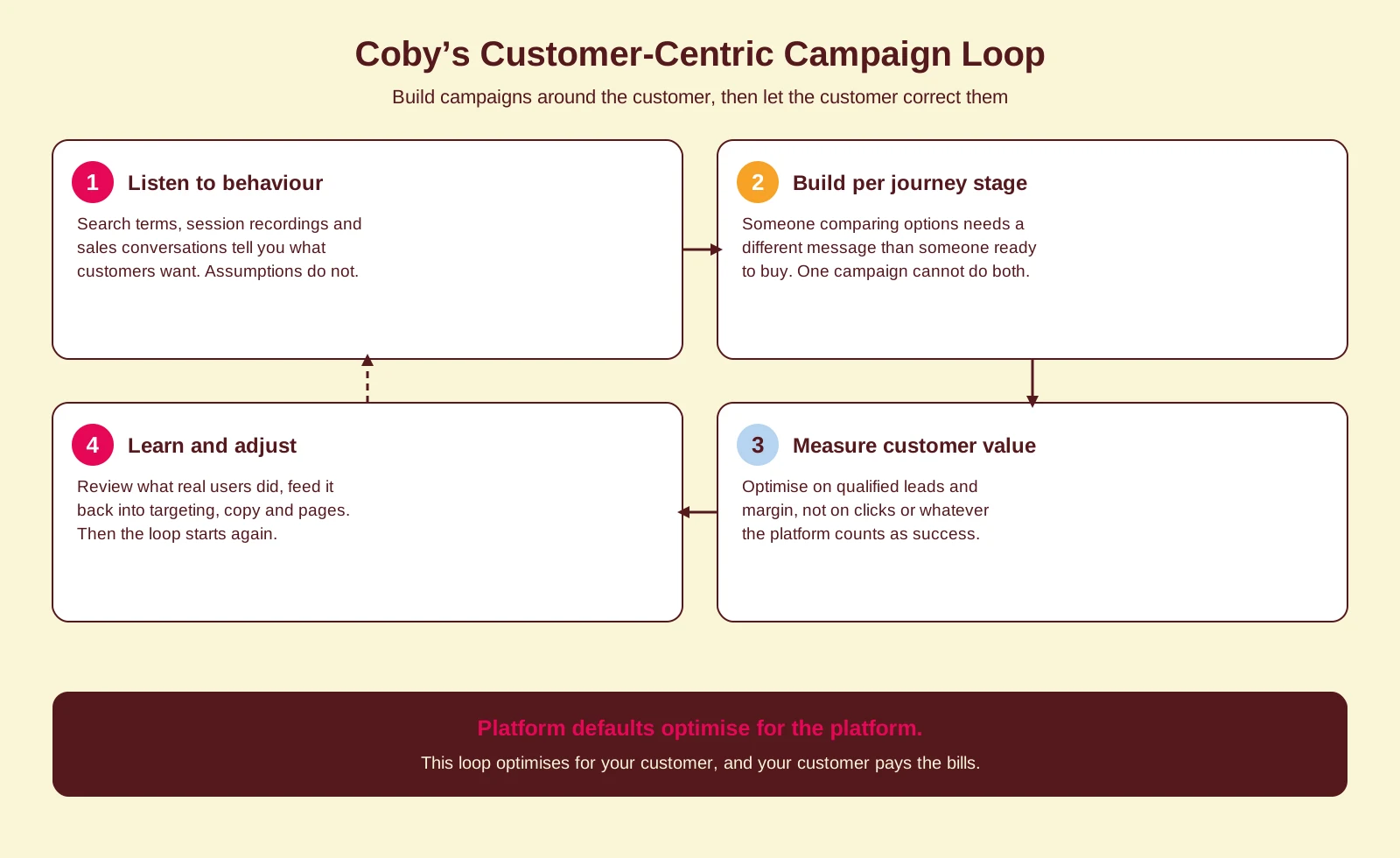
Step 1: Listen to behaviour, not assumptions
Your customers describe their needs every day, in your search terms report, in what they type into site search, in Microsoft Clarity session recordings, and in what they ask sales on calls. That raw material beats any persona workshop. If you want the measurement side of this, our comparison of Microsoft Clarity vs GA4 shows which tool answers which question.
Step 2: Build campaigns per journey stage
Someone searching “what is server-side tracking” is exploring. Someone searching “server-side tracking agency netherlands” is ready to talk. They need different ads, different pages and different follow-up, and Google’s audience segments let you treat them differently. For the earlier stages, Demand Gen campaigns reach people who are not searching yet; search campaigns then capture the demand once it exists.
Step 3: Measure customer value, not platform metrics
A customer-centric campaign is optimised on what a customer is worth, not on what a platform counts. That means tracking qualified leads instead of form fills, and margin instead of revenue where possible, the thinking behind POAS vs ROAS. It also means your first-party data feeds those signals back to the platforms.
Step 4: Learn and adjust
Review weekly what real users did: which search terms converted, where recordings show friction, which message won. Feed it back into targeting, copy and landing pages, and the loop starts again. Our guide to conversion rate optimisation covers the on-site half of that loop.
What it looks like in practice
Two quick examples make the loop less abstract.
A B2B software company. The search terms report shows prospects searching “excel alternative for planning” far more often than the product name. Customer-centric means building an ad group and landing page around that exact frustration, in the prospect’s words, instead of pushing brand campaigns at people who have never heard of you. Mid-funnel content answers the comparison questions sales keeps hearing; only the bottom-stage campaign asks for a demo.
A webshop. Recordings show mobile visitors abandoning at shipping costs, and search terms show demand clustering around one product category. Customer-centric means fixing the shipping surprise before raising budgets, shifting spend towards the category customers are actually pulling, and excluding recent buyers from acquisition campaigns so the budget chases new customers, not people who already converted.
Nothing in either example requires enterprise software. It requires looking at behaviour and taking it seriously.
Common mistakes we see
Confusing demographics with understanding. Age and gender tell you who someone is, not what they need. Intent data, what people search, read and click, is the customer-centric signal. Demographics are at best a bid adjustment.
Treating platform defaults as a strategy. Broad targeting plus “maximise conversions” optimises for the platform’s definition of success. Customer-centric means you define success first, then let the automation chase it.
Buying personalisation tech before doing the homework. A tool that inserts first names into emails does not make you customer-centric. Knowing which three questions block a purchase does, and that knowledge usually sits in your search terms and sales calls, free of charge.
Optimising every channel on clicks. If the dashboard rewards cheap engagement, budget drifts towards bargain hunters and away from buyers. Decide what a customer is worth before you decide where the budget goes.
How Coby approaches this
Customer-centric strategy is one of the two legs Coby stands on. The other is tracking, and they depend on each other: you cannot build around customer behaviour you are not measuring correctly. That is why every engagement starts with the measurement layer, the approach we describe in tracking-first performance marketing, before a single campaign is restructured.
What it delivers: for one B2B client we rebuilt the measurement so campaigns optimised on qualified leads instead of raw form fills, then rebuilt campaigns around journey stages. Lead flow went from 2 to 3 leads per month to 4 to 5 per week. Same budget, different centre of gravity.
The campaign work sits within a broader plan, which is what our marketing strategy service covers, and how all the channels fit together is laid out in our PPC strategy guide. If you want to know how customer-centric your current setup really is, our free audit looks at your account through your customers’ eyes: what they search, what they get shown, and where they drop off.
Conclusion
Customer-centric marketing is not a slogan or a software category. It is a loop: listen to real behaviour, build per journey stage, measure customer value, adjust. Run that loop consistently and your budget shifts, almost mechanically, towards the people most likely to become customers.
Want a second pair of eyes on whether your campaigns are built around your customers or around habit? Get in touch.
FAQ
What is customer-centric marketing in simple terms?
It is a way of working where customer behaviour, what people search, ask and do, decides your targeting, messaging and measurement. The opposite is building campaigns on assumptions and platform defaults.
How is customer-centric marketing different from traditional marketing?
Traditional marketing broadcasts one message to a broad group. Customer-centric marketing matches different messages to different moments in the customer journey, based on evidence of intent.
Is customer-centric marketing the same as personalisation?
No. Personalisation is one tactic, and often a superficial one. You can be deeply customer-centric with zero personalisation tech, simply by matching keywords, ads and pages to real intent.
What data do I need to get started?
Most SMEs already have it: search terms reports, GA4, session recordings from a free tool like Microsoft Clarity, and notes from sales conversations. The constraint is rarely data, it is acting on it.
How does understanding search intent improve performance?
It lets you match keywords, ads and landing pages to what people actually mean, so you stop paying for clicks from people looking for something else. That typically improves both conversion rate and return on ad spend.
How do I measure whether my marketing is truly customer-centric?
Check what your campaigns optimise on. If the primary signal is qualified customers or margin, you are customer-centric in practice; if it is clicks or raw form fills, not yet.
Written by Marloes Slotboom, founder of Coby Agency.
Last updated: October 2026