
Your Search campaigns are running, Shopping is ticking over, and yet growth has flattened. Sound familiar? Then you are probably the SME marketer or founder wondering whether demand gen campaigns deserve a slice of your Google Ads budget.
The honest answer: sometimes yes, often not yet. Demand gen campaigns reach people who are not actively searching but are open to your offer. That is a different game from bidding on “buy winter coat Amsterdam”. Different audience, different creative and, above all, a different yardstick.
In this article you will learn where Demand Gen ads actually appear in 2026 (it is more than most blogs claim), which KPIs to set, and when you should fix something else first. Including Coby’s Demand Gen Readiness Check, so you do not pour budget into an algorithm blind.
After reading, you will be able to:
- Explain where Demand Gen ads run in 2026, and set the channel controls to match
- Choose KPIs that fit mid-funnel campaigns instead of copying Search logic
- Judge whether your account is ready, using a concrete checklist
- Spot the four most common mistakes before they cost you money
No miracle-cure story here. Just a decision framework from an agency that would rather audit your tracking than inflate your invoice.
What demand gen campaigns are and where they run in 2026
Demand Gen is a Google Ads campaign type that shows visual and video ads across YouTube (including Shorts), Google Discover, Gmail and, since 2025, the Google Display Network. If an article tells you it is only YouTube, Gmail and Discover, that article is out of date.
A quick history lesson. Demand Gen replaced Discovery campaigns, and that migration completed in early 2024 (between January and March 2024). Since then Google has kept expanding the format. In 2025 the Google Display Network became available as a channel inside Demand Gen, replacing the separate video partners network. Google has also announced that classic Display campaigns are getting a new home inside Demand Gen.
The good news: you decide where your ads run. Through channel controls you toggle YouTube, Discover, Gmail and Display individually, and Maps has since been added as a channel too. That matters for local businesses; we cover Demand Gen ads in Maps in our post on local advertising with Google Ads.
In practice it works like this: someone who just watched three espresso machine reviews on YouTube sees your coffee brand’s ad in their Discover feed, without ever clicking a keyword you target. That is the whole point of Demand Gen.
What about Performance Max? Briefly: PMax runs across nearly all Google inventory at once, including Search and Shopping, and decides for itself where your budget goes. Demand Gen gives you more control over audiences and creative within the visual channels. If you run both, exclude overlapping audiences to limit internal competition. A full comparison deserves its own article and one is on our schedule; until then, our advanced Performance Max strategies are here.
Which KPIs to measure (and why Search logic fails here)
You measure demand gen campaigns on a mix of click-through, engaged-view and view-through conversions, plus the effect on your brand search volume. Judge them on last-click CPA alone and you will almost always draw the wrong conclusion.
The three conversion types:
- Click-through conversions. Someone clicks your ad and converts. The classic.
- Engaged-view conversions. Someone watches at least 10 seconds of your video (or the whole video if shorter), does not click, but converts later anyway.
- View-through conversions. Someone sees your ad, does not click, and converts later through another channel.
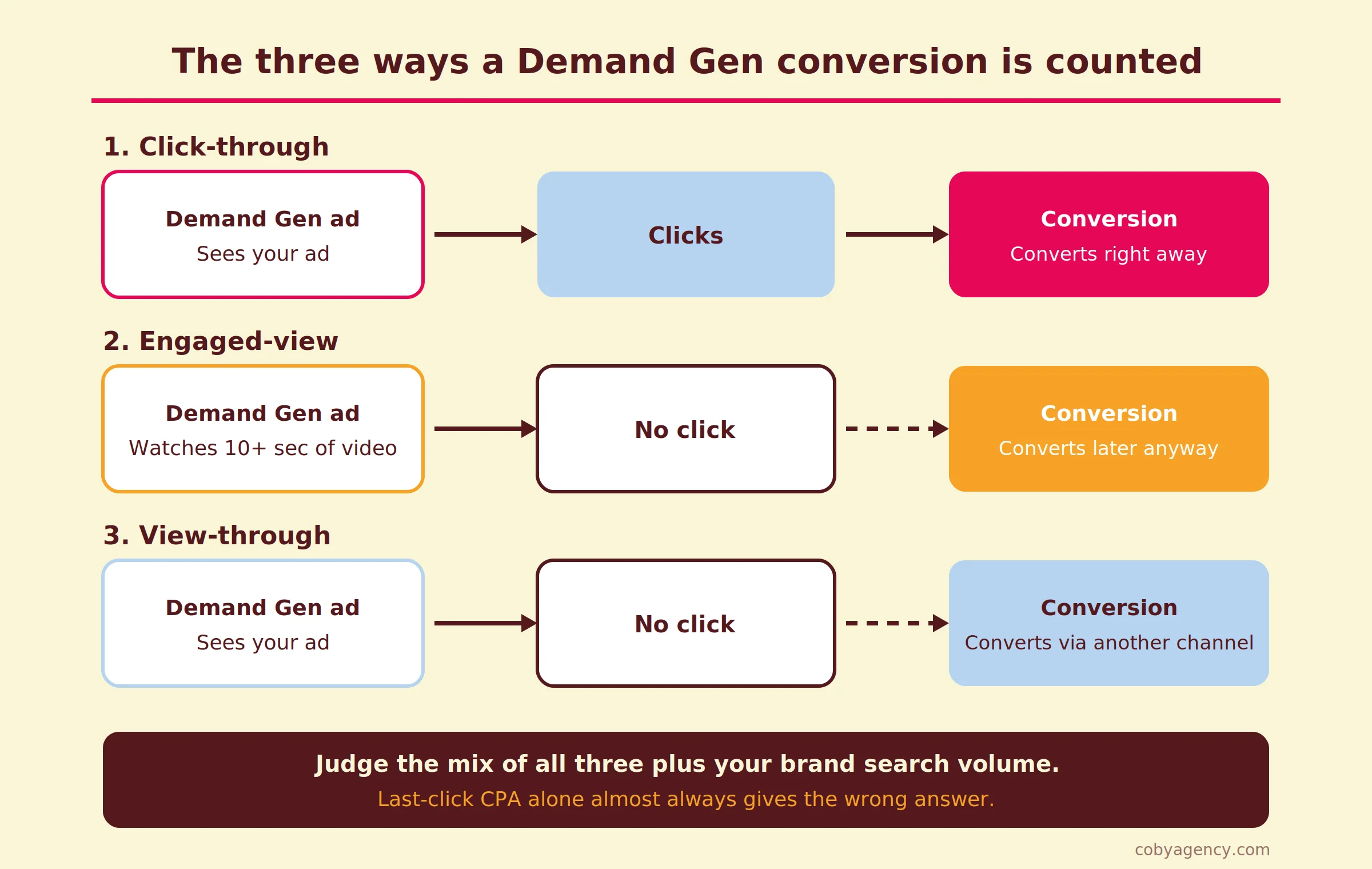
Alongside those, watch your brand search volume. If searches for your brand name rise consistently during a Demand Gen flight, the campaign is doing work the campaign report will not show you. How big that effect is varies by brand, budget and market. Distrust anyone who quotes a fixed percentage without measuring it.
The first question we ask on any google ads demand gen account: which conversions count in the report, and how are the attribution model and lookback windows configured? If view-through conversions count with a generous window, a campaign can look brilliant on paper while its real revenue impact stays unclear.
And all of this only works if your conversion data is trustworthy. Optimising Demand Gen on broken tracking is like feeding a sat nav the map of the wrong city: it calculates perfectly and sends you confidently in the wrong direction. Start with the most common Google Ads tracking problems.
When demand gen campaigns deserve budget (and when they do not yet)
Demand Gen deserves budget once the bottom of your funnel is solid: stable Search and Shopping results, reliable tracking and enough conversion volume to feed the bid strategy. Missing any of the three? Then Demand Gen is premature.
Demand Gen runs entirely on Smart Bidding, and that algorithm needs data to learn. If you want to bid to Target ROAS, Google’s guidance is at least 50 conversions in the past 30 days. Well below that? Start with Maximise Conversions and keep expectations modest.
On budget: there is no hard minimum in euros, whatever you read online. Our working rule is simple. Your daily budget must be high enough to get through a learning phase of several weeks and produce conversions, or clear micro-conversions, every week. If the only way to fund that is stripping your best-performing Search campaigns, wait.
Who does it suit? Brands with visually strong products and the capacity to produce video: lifestyle, fashion, food, beauty, interiors. B2B works too, with sharp audience segmentation and patience, since the buying cycle is longer; our post on Q4 B2B marketing strategies covers how mid-funnel activity feeds a longer pipeline. And if you are weighing this budget against Meta’s mid-funnel inventory, read Google Ads vs Meta Ads first.
Coby’s Demand Gen Readiness Check
Work through these seven steps before you launch a demand gen campaign. Every step you skip, you pay back later in unreadable data. Consider this our version of demand gen best practices, in checklist form.
- Verify your conversion tracking. Are your conversion actions, deduplication and consent settings correct? Without clean data, every following step is pointless.
- Check your conversion volume. Does the account generate enough conversions for your chosen bid strategy? For Target ROAS, Google’s guidance is 50 conversions per 30 days.
- Build creative variety. At least three to five images in multiple ratios and at least one short video (under 30 seconds). One static banner leaves most of the inventory untouched.
- Load your audience signals. Customer lists, website visitors segmented by intent, YouTube viewers and lookalikes built from your best customers.
- Set your channels deliberately. Use channel controls to enable only the channels that fit your goal, knowing that Display and Maps are now part of the mix.
- Agree the yardstick upfront. Which conversion types count, which attribution model applies, and what is an acceptable CPA for mid-funnel traffic?
- Schedule the evaluation. Review after the learning phase, in weeks rather than days. Daily tinkering keeps resetting the algorithm.
Common mistakes with demand gen campaigns
Most failed Demand Gen tests do not fail on the campaign type; they fail on how they were judged. These are the four mistakes we see most often.
1. Judging on last-click. Someone sees your Demand Gen ad on Monday, searches your brand on Tuesday and converts through your brand campaign. Last-click hands brand all the credit. That is like crediting the till assistant with the entire sale because they processed the card payment.
2. Launching with one creative. The algorithm tests combinations of images, videos and copy per placement. Give it a single image and there is nothing to test, and a large share of the inventory stays out of reach.
3. Skipping audience signals. Without customer lists or visitor segments, the algorithm starts from zero, and your learning phase gets longer and more expensive. Your first-party data is the starting point, not an optional extra.
4. Measuring it like Search. Copy your Search CPA targets straight onto Demand Gen and you will pull the plug within a fortnight. Mid-funnel traffic sits further from the purchase; your targets should reflect that.
How Coby approaches this
At Coby, every Demand Gen campaign starts with the data, not the ads. Tracking-first means we verify the conversion signals Google Ads receives before anything else, usually through server-side tracking with GTM and Taggrs. Only then do we talk creative and budget.
We also build campaigns around the customer journey rather than platform defaults. Demand Gen traffic is less purchase-ready than Search traffic, so we match landing pages, ads and KPIs to that stage. How we set up and report conversion data is on our data analytics page.
That approach delivers. For De Eenhoorn (OneMeeting Group) we achieved a 1,500% ROAS, and a lead generation client went from 2 to 3 leads per month to 4 to 5 per week. Marloes also spent years at Google itself as an Agency Account Strategist for Benelux and Nordics, so she knows how these systems behave from the inside.
Conclusion: fundamentals first, then create demand
Demand gen campaigns in 2026 are a serious channel, with more inventory and more control than ever. But they only reward advertisers who have their tracking, conversion volume and creative in order, and who measure with a mid-funnel yardstick instead of Search logic.
Not sure whether your account is ready? Book a free 30-minute call with Marloes. We will walk through the Readiness Check together and tell you honestly whether Demand Gen deserves budget now, or whether your money works harder elsewhere. More guides live on our blog.
Frequently asked questions about demand gen campaigns
What are demand gen campaigns in Google Ads?
Demand gen campaigns are a Google Ads campaign type that shows visual and video ads to people who are not actively searching yet. They run on Smart Bidding and use Google’s audience signals to create demand rather than capture existing demand.
Where do Demand Gen ads appear in 2026?
On YouTube (including Shorts), Google Discover, Gmail and the Google Display Network. Channel controls let you choose which channels are active, and Maps has been added as a channel as well. The old “only YouTube, Gmail and Discover” description has been outdated since 2025.
What is an engaged-view conversion?
An engaged-view conversion counts when someone watches at least 10 seconds of your video ad (or the full video if it is shorter), does not click, but converts afterwards anyway. It sits between a click conversion and a view-through conversion.
How many conversions do you need before Demand Gen makes sense?
There is no official minimum for the campaign type itself, but for Target ROAS bidding Google’s guidance is at least 50 conversions in the past 30 days. Well below that, choose Maximise Conversions or optimise your Search and Shopping campaigns first.
Does Demand Gen work for B2B?
Yes, with adjusted expectations. B2B audiences are smaller and buying cycles are longer, so measure on leads, demo requests or content downloads rather than direct sales. Sharp segmentation based on your own customer data separates reach from waste.
What is the difference between Demand Gen and Performance Max?
Performance Max runs across nearly all Google inventory at once, including Search and Shopping, and gives Google maximum freedom. Demand Gen focuses on the visual channels and gives you more control over audiences and creative. A full comparison is coming in a separate article soon.
Written by Marloes Slotboom, founder of Coby Agency.
Last updated: August 2026