
Most PPC accounts we audit look fine on the surface. Tidy keyword lists, split-tested ads, decent quality scores. Then we ask the founder or marketing manager one question: which campaigns are producing profitable customers? Silence.
If your data cannot answer that question, your PPC strategy is guesswork with a dashboard on top. This guide is for founders and marketing managers who run their own Google Ads, or manage an agency that does, and want paid search to feed the wider marketing engine instead of living in its own bubble.
After reading, you will know how to set up tracking that optimises on revenue rather than vanity conversions, structure campaigns around margin and funnel stage, make paid search work with your SEO and paid social, and use Smart Bidding and Performance Max without handing over all control.
What a PPC strategy actually is in 2026
A PPC strategy is the set of decisions that connects paid clicks to revenue: what you measure, how you structure campaigns, where budget goes and which signals you feed Google’s automation. It is not a keyword list.
That distinction matters more than ever. Smart Bidding, broad match and Performance Max mean Google’s systems make thousands of bidding decisions for you every day. Your job has shifted from managing bids to managing inputs: conversion data, structure and budget boundaries.
Feed the machine clean signals and it compounds your results. Feed it noise and it optimises hard on exactly the wrong thing.
Coby’s PPC Strategy Stack: four layers, in order
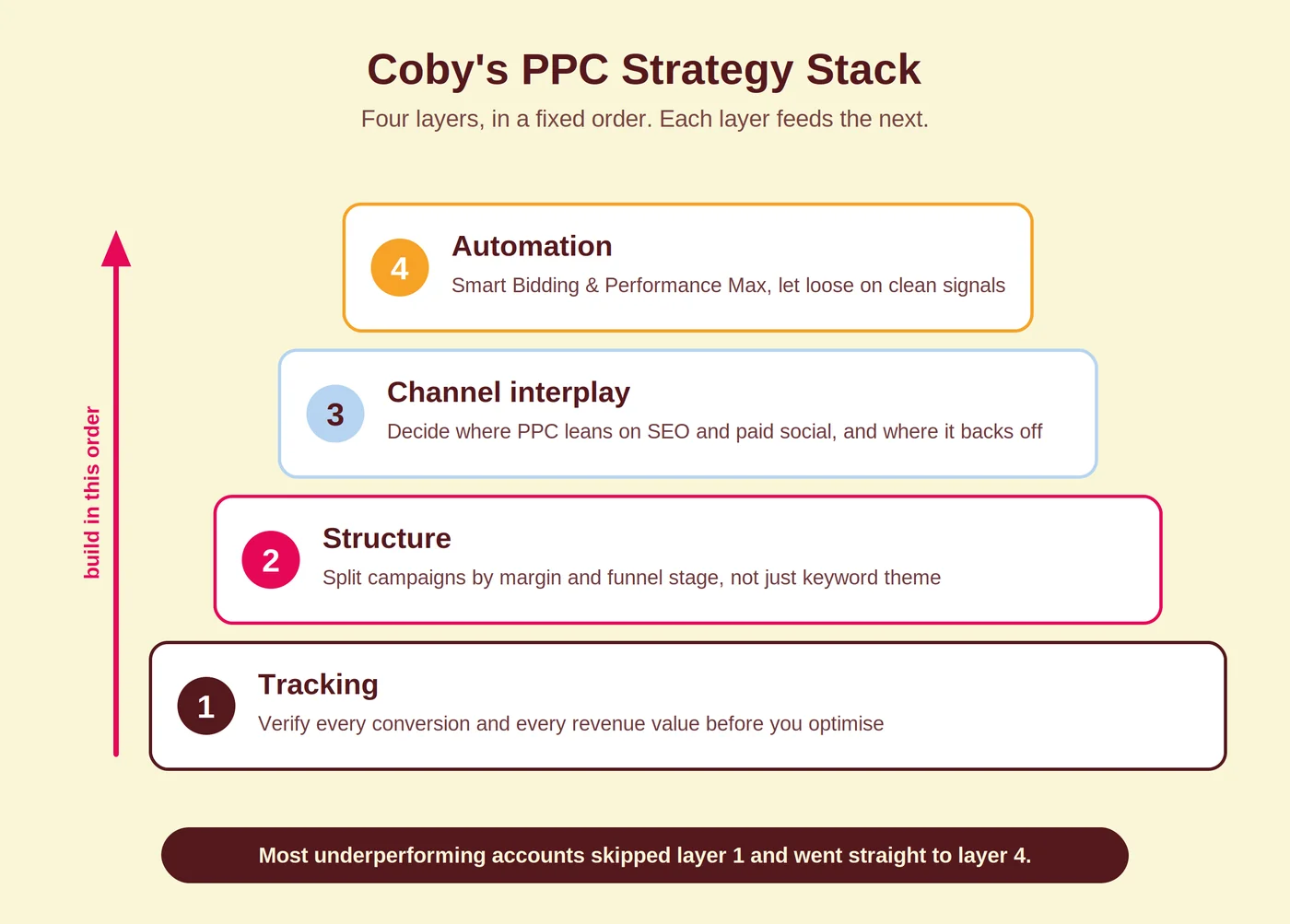
We build every account through the same four layers, in this order:
- Tracking. Verify that every conversion and every revenue value is real before you optimise anything.
- Structure. Split campaigns by margin and funnel stage, not just by keyword theme.
- Channel interplay. Decide where PPC should lean on SEO and paid social, and where it should back off.
- Automation. Turn on Smart Bidding and Performance Max once layers 1 to 3 give them something worth optimising on.
The order is the point. Most underperforming accounts we see skipped layer 1 and went straight to layer 4.
Layer 1: tracking before bidding
Almost every PPC guide starts with keyword research. Fair enough, keywords matter. But the first question worth answering is: where does revenue leak in the current setup?
Here is a pattern we keep running into. An ecommerce store tracks “purchase” as its conversion action, but the tag fires on the order confirmation page, which also loads when a customer re-opens an old order. Google counts those repeat views as new purchases. Smart Bidding then believes certain keywords convert brilliantly, and bids up terms that look profitable but are not.
Before any strategy conversation, verify three things in Google Tag Manager: does the conversion tag fire exactly once per real transaction, are revenue values passed correctly, and is there deduplication between client-side and server-side events if both are running?
None of this is glamorous. It determines whether your spend makes money or just looks like it does. Our guide to Google Ads conversion tracking covers the setup step by step, and our tracking-first approach explains why we never skip it. For hands-on help, there is our data and analytics service.
Layer 2: structure follows margin and funnel stage
Classic account structure advice was written for a world where you controlled exactly which searches triggered your ads. That world is mostly gone. Structure now exists to give the algorithm clean boundaries.
Brand campaigns stay separate. Always. Branded terms convert at a completely different rate. If they share a budget or a CPA target with non-brand, the algorithm quietly shifts spend towards brand every time targets get tight, and you lose sight of real non-brand performance.
High-margin products get their own campaigns. If one product line carries a 60% margin and the rest sit at 20%, they should not share a single ROAS target. You want to bid aggressively on the high-margin line even at a lower return, because the profit still justifies it. Feeding profit values instead of revenue into bidding is exactly what POAS bidding is for.
Top-of-funnel traffic gets its own budget line. Broad match and Performance Max used for new-audience acquisition should not compete with your bottom-funnel exact match terms for the same budget. New audiences cost more per conversion and have a different job: filling the retargeting pool and driving branded search volume later.
And broad match itself? Pair it with Smart Bidding, which evaluates each query in real time, and use it in accounts where conversion signals are clean. Broad match on manual bids with messy tracking is how budgets vanish.
Layer 3: make PPC, SEO and paid social compound
Paid search does not operate in a vacuum, yet most PPC guides treat it that way. This is where mid-size accounts leave the most money on the table.
If you hold position 1 organically for a term, bidding aggressively on that same term often pays for clicks you would have received anyway. The honest way to find out is a hold-out test: pause the paid term for a few weeks and watch total traffic and total revenue for that term, not just paid clicks. Sometimes the ad adds real incremental volume. Sometimes it is structural waste. The data decides, not the opinion.
Paid social plays a different role: it creates demand instead of capturing it. When Meta campaigns run well, branded search volume in Google Ads typically rises, because people see the product first and search for the brand later. Those visitors tend to convert better; they arrive pre-sold. We cover how the two platforms divide the work in Google Ads vs Meta Ads.
Inside Google’s own ecosystem, Demand Gen campaigns sit between those two worlds: they create demand on YouTube, Discover and Gmail while feeding the same conversion signals as your Search campaigns.
Layer 4: Smart Bidding and Performance Max without losing control
Smart Bidding is an execution layer, not a strategy. Whether it helps depends entirely on what you feed it.
Volume matters. For Target ROAS on Search and Shopping campaigns, Google recommends at least 15 conversions in the past 30 days at conversion tracking level, and around 50 conversions in 35 days for Demand Gen. After launch or after any target change, give the system one or two conversion cycles before judging it.
Below those volumes you have two sensible options: consolidate campaigns so more signal flows through each one, or run manual CPC or Target Impression Share while you build volume. Manual bidding is not old-fashioned; it is appropriate for the data situation you are actually in.
One more thing to watch: keep the action that generates revenue as your primary conversion action, and demote micro-conversions such as newsletter sign-ups to secondary. Otherwise bidding drifts towards easy conversions, and the numbers look better while quality falls.
Performance Max deserves its own paragraph, because the old criticism, that it is a black box, is now only half true. Since 2025, Google has added channel-level reporting, full search terms reporting, campaign-level negative keywords (up to 10,000 per campaign) and brand exclusions to PMax. Use all of them.
Check the search terms weekly. If branded conversions make up a growing share of PMax results, the campaign is cannibalising your Search campaigns and flattering its own ROAS. We treat PMax as a complement to Search, never a replacement. More depth in our guide to advanced Performance Max strategies.
Measure long-term value, not last week’s ROAS
Google Ads offers two attribution models today: data-driven attribution (DDA) and last click. Nothing else is left.
Last click flatters branded and retargeting campaigns and undersells the generic terms that introduced the customer in the first place. DDA is the better default, but it only sees Google’s part of the journey.
For real allocation decisions, cross-reference Google Ads with your CRM or backend order data. The numbers we steer on: cost per new customer rather than cost per conversion, revenue per customer over the first 90 days, and the gap between platform-reported conversions and actual orders or leads. That last gap is your tracking health check.
How Coby approaches this
We run the same four-layer stack on every account, and we start at layer 1 even when a client asks us to start at layer 4. Best-in-class tracking is the foundation everything else stands on; most agencies treat it as an afterthought.
A real example: a B2B client came to us generating 2 to 3 leads per month from paid campaigns. We redefined what counts as a lead together with their sales team, rebuilt the measurement so campaigns optimised on qualified leads, and restructured around that signal. The same budget now produces 4 to 5 qualified leads per week.
No magic keywords, no secret scripts. Layers 1 and 2 did the work; layer 4 simply got better inputs.
If you are comparing agencies for this, our guide on how to pick a Google Ads agency tells you exactly what to ask, including what to ask us.
Conclusion
A PPC strategy that feeds your whole marketing comes down to four layers in a fixed order: verify tracking, structure by margin and funnel stage, coordinate with SEO and social, then let automation loose on clean signals. Get the order right and every euro of spend teaches you something.
Want to know where your account leaks? Get in touch for a tracking-first audit of your paid search setup.
FAQ
Does PPC work for small budgets?
It depends on the market. In competitive sectors, a small budget rarely generates enough conversions for Smart Bidding to work well, which means manual management and tight keyword targeting. In niche B2B or local categories, a modest budget can deliver consistent leads if the structure is tight and the tracking is clean.
How long does it take for a new PPC campaign to perform properly?
Give Smart Bidding one or two conversion cycles after launch or after a major change before judging it. The lower your conversion volume, the longer that takes in calendar time. Judge a new campaign’s ceiling over months, not weeks.
What is the difference between PPC and paid social?
PPC on Google or Microsoft captures demand that already exists: people searching for something specific. Paid social on Meta, TikTok or LinkedIn creates demand by putting your product in front of people who are not searching yet. Most growing brands need both; the budget split depends on how much search volume your category has.
Should I pause PPC on keywords where I rank organically?
Sometimes, yes. Run a hold-out test: pause the paid term for a few weeks and monitor total traffic and revenue for that keyword, not just paid clicks. The answer varies by keyword competitiveness and by how much the ad adds above your organic result.
What is POAS and why does it matter for PPC bidding?
POAS stands for profit on ad spend. ROAS optimises towards revenue, which treats a low-margin sale the same as a high-margin one. POAS feeds actual profit values into the bidding algorithm, so budget flows to the products and keywords that make you money rather than the ones that only make you turnover.
How do I know if my PPC tracking is accurate?
Compare your conversion count in Google Ads with actual orders or leads in your CRM or backend over the same period. A consistent, sizeable gap points to duplicate firing, missing tags or incorrect event configuration. Server-side tagging helps close the part of the gap caused by ad blockers and browser privacy restrictions.
Last updated: September 2026
Written by Marloes Slotboom, founder of Coby Agency