
A pattern I see often in new accounts: the Google Ads dashboard looks healthy, with decent click-through rates and solid impression share, but revenue is flat. Then the tracking audit finds conversions firing twice and spam form submissions counted as leads. The conversion rate was never a marketing problem. It was a measurement problem.
That is the thing most conversion rate optimisation (CRO) guides skip over entirely: before you start changing button colours or rewriting headlines, you need to know whether your numbers are telling you the truth.
If you are a founder or marketing manager running your own campaigns without a dedicated experimentation team, this guide is for you. Here is what you should be able to decide after reading:
- Whether your current conversion tracking is reliable enough to base CRO decisions on
- How to approach CRO in a way that connects to real revenue, not just on-site metrics
- Which CRO tactics actually apply to small and medium businesses without a dev team on call
- How to run A/B tests without splitting your traffic so thin that the results are meaningless
- When CRO is the right lever, and when you should fix the channel first
Fix the measurement before you touch the page
CRO stands for conversion rate optimisation: improving the percentage of visitors who take a desired action, whether that is a purchase, a form fill, a phone call or a booking. Simple idea. But every optimisation decision you make depends on the data you are reading, and bad tracking produces confident-sounding numbers that point you in completely the wrong direction.
The first thing I do on any new account is a tracking audit. Are conversions firing once per action? Are all channels attributed correctly? Is the goal you are optimising for the one that actually drives revenue, or a proxy metric that felt measurable at setup time? If you run Google Ads on noisy conversion data, Smart Bidding is learning from garbage. It will optimise toward whatever signal you give it, including the wrong one.
A few issues that come up constantly in audits: duplicate conversion tags left over from a developer’s testing setup, thank-you pages that load twice on mobile and double-count, and phone call conversions set to count every call instead of one per user. None of these are exotic bugs. They are standard issues that compound quietly for months. Our guide to Google Ads tracking problems covers the most common ones in detail.
Once tracking is clean, you have a real baseline. Only then does CRO mean something. Our tracking and data analytics work always starts here, because everything downstream depends on it.
What your conversion rate is actually telling you (and what it is not)
A 2% conversion rate on your website does not mean 98% of visitors are not interested. It means 98% of visitors did not convert during that session, on that device, on that visit. These are different things.
Conversion rates also vary enormously by traffic source. Branded search traffic converts far better than generic non-brand traffic, because those visitors were already looking for you. Organic visitors landing on a blog post convert at a fraction of either, and that is not a CRO failure: someone reading an informational article is usually not in a buying mindset yet. Average all of that into one site-wide conversion rate and the number is technically accurate and practically useless.
So segment before you optimise. Look at conversion rates by channel, by landing page, by device, and by new versus returning visitors. When you do, the real problem tends to surface fast. Maybe mobile converts at a quarter of desktop, which points at friction in the mobile checkout. Maybe your paid social landing page has a sky-high bounce rate because the ad promised one thing and the page delivers another. These are specific, fixable problems. A blended conversion rate hides all of them.
CRO without a dev team: where to start
Most CRO content assumes a full-time experimentation team, tens of thousands of monthly visitors and a developer on call. If that is not you, here is a more grounded approach.
Start with qualitative data before you test anything. Microsoft Clarity is free and gives you session recordings and heatmaps; Hotjar does the same on paid plans. Spend two hours watching recordings on your highest-traffic landing page. You will see things no A/B test would have told you: a form field that confuses people, a call to action that sits below the fold on certain screens, a trust badge that fails to load.
Fix the obvious friction first. Then test. Google Optimize was discontinued in September 2023, so testing now runs through tools like VWO or Convert. Be honest about your volume before you start: a standard A/B test needs a few hundred conversions per variant before it says anything reliable, and the exact number depends on your baseline rate and the size of the effect, so run your figures through a sample size calculator before trusting any result. If your site does fewer than about fifty conversions a week, a split test will take months. In that case, session recordings, usability tests and direct customer interviews give you more reliable direction, and you simply implement clear improvements without splitting traffic.
I am a genuine nerd about customer interviews as a CRO input. Talking to five customers who almost bought but did not is worth more than a month of heatmap data. Ask what they were looking for, what made them hesitate, and what would have tipped them over. The answers are almost always specific and actionable in a way that aggregate data is not.
CRO in a multi-channel campaign: where it fits and where it does not
A lot of what gets treated as a CRO problem is really a channel mismatch. If someone clicks a Meta ad for a specific product and lands on your homepage, the poor conversion rate on that page is not a CRO problem. The page was never designed for that intent. Fix the ad destination before you start tweaking page copy.
The same logic applies across Google Ads and Meta: message match between the ad and the landing page is a bigger conversion lever than almost any on-page element you could test. Consistent creative, consistent offer, consistent headline. Once that alignment exists, you have a real landing page to optimise. Before it exists, you are testing the wrong variable. The two platforms also send very different intent, which is exactly why we compared them in Google Ads vs Meta Ads.
Page type matters too. Product and category pages should be optimised for the hard conversion. Blog content should be optimised for the micro-conversion that fits that stage of intent: an email signup, a guide download, a click through to a relevant product page. Pushing hard conversions from informational content usually hurts both the conversion rate and the content itself, because the page ends up serving neither purpose well.
The tests worth running and the ones worth skipping
Not every A/B test is worth the traffic it costs. Testing a headline change while your checkout loses a huge share of buyers at the payment step is the wrong priority. Audit the full funnel first, then decide what to test.
High-impact tests for most e-commerce and lead generation sites:
- Fewer checkout steps and fewer form fields
- A clearer above-the-fold value proposition
- More specific calls to action (“Book a free 30-minute audit” tends to beat “Get in touch” in B2B contexts, though you should validate that for your own audience)
- Social proof placement near the point of decision
Nielsen Norman Group’s UX research consistently shows that users scan in predictable patterns and rarely scroll deep on a first visit, which means your most persuasive content has to earn its position high on the page.
Lower-impact tests that get over-indexed: button colour, font size, stock photo versus illustration. They can move the needle, but they rarely produce the sustained lifts that structural changes do.
And one habit worth building: CRO is not a project with an end date. Seasonality, new traffic sources and catalogue changes all shift conversion behaviour. Review conversion rates monthly, segmented by channel, and treat unexpected drops as a signal to investigate rather than a number to explain away.
How Coby approaches this
Coby’s CRO work follows a measurement-first loop: verify the tracking, segment the data, fix the obvious friction, then test where the volume allows it. Best-in-class tracking comes first because every later step depends on it, and it is the part most agencies skip. Where volume is too low for testing, we lean on qualitative research rather than pretending an underpowered test is evidence.
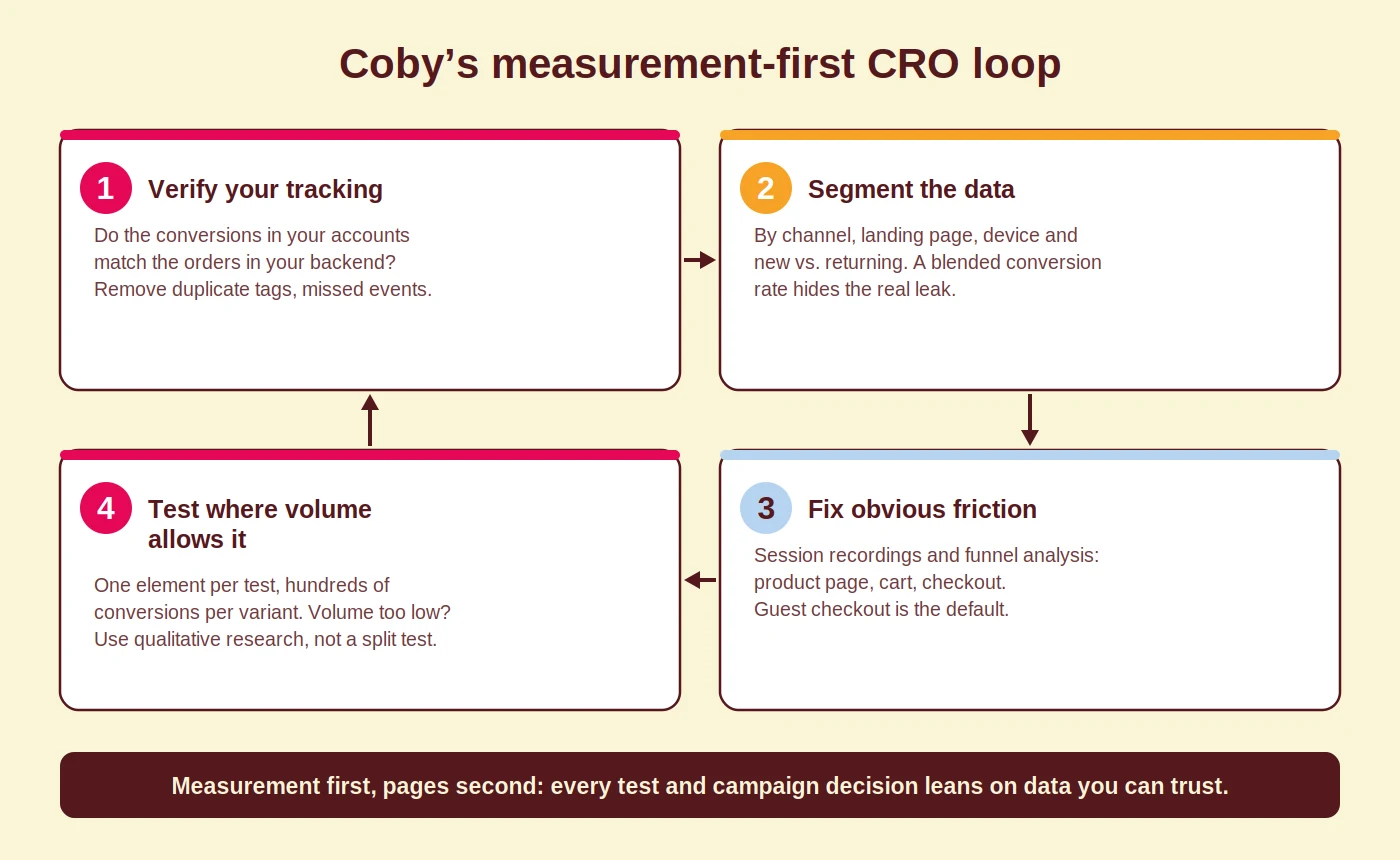
That loop runs inside our broader performance marketing work, because conversion improvements and paid traffic feed each other: a higher conversion rate lowers your effective cost per acquisition, which buys more room in the auction. If your numbers do not add up and you want a tracking audit that catches what other agencies miss, get in touch and tell us what you are seeing.
Frequently asked questions
What is a good conversion rate for my website?
There is no universal benchmark that holds across industries, traffic sources and price points. Branded traffic converts far better than non-brand, and informational content converts less than product pages by design. Segment by channel and page type first, then benchmark against your own historical data rather than industry averages.
How do I know if my conversion tracking is accurate?
Review your tag setup in Google Tag Manager for duplicate conversion events, and cross-reference conversion counts against your CRM or order records over the same period. A significant mismatch usually points to double-firing, missed events or spam submissions being counted. A structured tracking audit catches these systematically.
Do I need a lot of traffic to run A/B tests?
You need a lot of conversions, which is stricter than traffic. As a working rule, plan for a few hundred conversions per variant and confirm the exact requirement with a sample size calculator. Below roughly fifty conversions a week, qualitative methods such as session recordings, customer interviews and usability testing give you more reliable direction than an underpowered test.
Should I optimise landing pages differently for paid search versus paid social?
Yes. Paid search visitors arrive with a specific need they typed themselves, so get to the offer fast. Paid social visitors were interrupted mid-scroll, so the page has to establish relevance and desire first. Lead with the problem for social; lead with the offer for search.
How does CRO connect to SEO?
A page that holds attention and satisfies intent tends to perform better in search over time, so optimising the experience benefits both. The tension appears when informational pages get pushed toward hard conversions prematurely: engagement drops and neither goal is served. Keep conversion goals appropriate to each page’s intent.
What should I fix first: the ads or the landing page?
Check message match first. If the ad and the landing page disagree on offer, audience or tone, fix that before touching the page. Then look at mobile experience and page speed, which affect both Quality Score and real behaviour. Structural changes such as form length and checkout steps usually beat copy tweaks.
Last updated: August 2026
Written by Marloes Slotboom, founder of Coby Agency