
Every brand says it wants to connect with its audience. Most settle for reaching them instead. The difference shows up in the numbers that matter: reach fills a dashboard, connection fills a pipeline.
This guide is for founders and marketing managers at small and medium-sized businesses who want to connect with your audience in a way that leads somewhere. Not vanity metrics, but engagement that turns into enquiries, sales and repeat customers. You will get a practical framework, examples from brands that do this well, and a way to measure whether any of it is actually working.
What connecting with your audience actually means
Connecting with your audience means building a relationship that works in both directions. People recognise your brand, respond to it and come back to it on their own, without being retargeted into submission. That is a different goal from reach, which only measures how many people scrolled past you.
A simple test: if you paused all your advertising tomorrow, would anyone notice? Would anyone email, search for your brand or ask where you went? If the honest answer is no, you have reach, not connection.
Google’s research into the messy middle of the buying journey shows why this matters commercially. Buyers loop between exploring options and evaluating them, often for weeks. Brands that feel familiar and trustworthy get pulled out of that loop more often. Connection is what makes you familiar before the buying moment arrives.
Coby’s Connection Ladder: four rungs from stranger to advocate
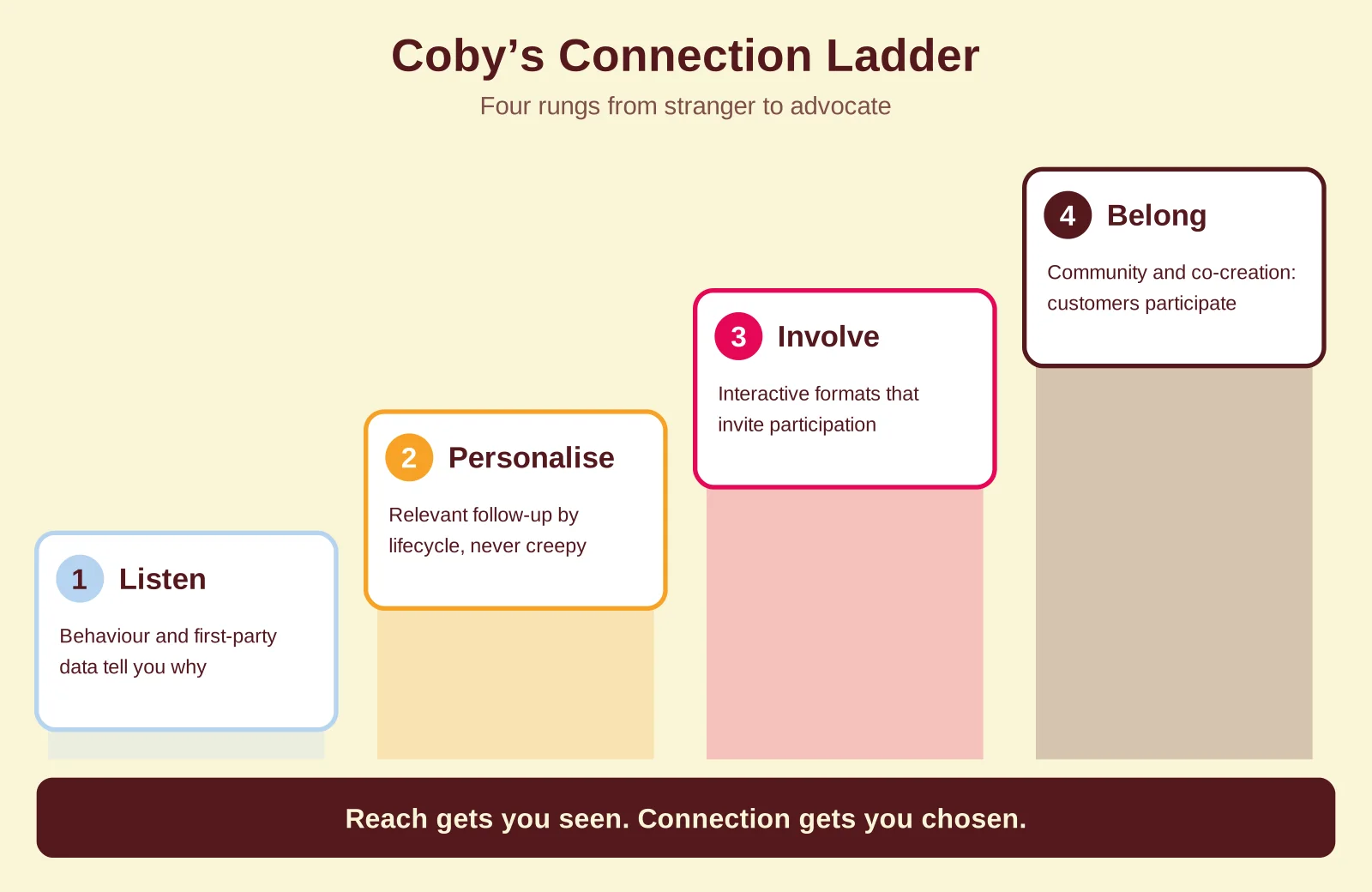
We use a simple framework for this with clients: the Connection Ladder. It has four rungs, and each one builds on the rung below it. Skip a rung and the ones above it wobble.
1. Listen: let behaviour tell you why
Connection starts with understanding, and understanding starts with data you can trust. Not more dashboards, but a clear view of what people actually do: which pages they read, where they hesitate, what they buy and what they come back for.
Your own first-party data is the richest source here, because it describes your customers rather than a lookalike of them. Pair it with a behaviour tool such as Microsoft Clarity and you can see not just what happened, but where people got stuck. We wrote a separate guide on how Clarity and GA4 complement each other for exactly this.
2. Personalise: be relevant without being creepy
Once you understand behaviour, you can respond to it. Personalisation at SME scale does not mean building a recommendation engine. It means sending the follow-up email that matches what someone looked at, showing returning visitors something different from first-timers, and using audience segments to adjust your message by lifecycle stage.
The line to watch: personalisation should feel helpful, like a shop assistant who remembers you. The moment it feels like surveillance, it breaks trust instead of building it. Relevance earns attention; precision theatre loses it.
3. Involve: invite participation
Attention you earn through participation lasts longer than attention you buy. Interactive formats such as quizzes, polls, calculators and live Q&As give people a reason to engage rather than scroll, and every interaction teaches you something about what they want.
There is a bonus here: answers people give you voluntarily (sometimes called zero-party data) are consent-friendly and usually more honest than inferred interests. A pricing calculator or a “which option fits you” quiz does double duty as content and as research.
4. Belong: build a community, not just an audience
The top rung is when customers start talking to each other, not just to you. User-generated content, customer stories, feedback loops and co-creation all signal the same thing: people feel like participants in the brand rather than targets of it.
For an SME this can be as simple as featuring customer projects, asking buyers to vote on your next product, or running a small event for your best clients. It does not need a platform. It needs consistency.
What big brands get right, and how to copy it at SME scale
The brands everyone cites for audience connection are useful, as long as you copy the mechanism and not the budget.
Netflix listens. Its recommendations are built on viewing behaviour, which keeps people watching content that fits them. The SME version: use purchase and browsing behaviour to drive your email flows and product suggestions, instead of sending everyone the same newsletter.
Duolingo involves. Streaks, leaderboards and bite-sized lessons turn learning into daily participation. The SME version: pick one interactive format that fits your offer, such as a quiz or calculator, and make it genuinely useful.

Tony’s Chocolonely tells a story. The mission against inequality in the cocoa trade is baked into everything, down to the unevenly divided chocolate bar. The SME version: say plainly why your company exists and let that show up consistently, from your about page to your packing slip.

Starbucks personalises. The app uses purchase history to serve offers that feel timely rather than random. The SME version: lifecycle emails. A first-time buyer, a regular and a lapsed customer should not get the same message.

LEGO builds belonging. LEGO Ideas lets fans submit designs and vote on what becomes a real product, turning customers into co-creators. The SME version: ask your customers what you should build, stock or write next, and credit them when you do it.

Measure connection, not just clicks
Engagement work often dies in the reporting meeting, because the metrics presented (impressions, likes, CTR) say nothing about connection. The signals that do are less glamorous: returning visitors, branded search volume, email replies, repeat purchase rate and the time between purchases.
None of those live in an ads dashboard. They live in your analytics and your customer data, which is why the measurement layer has to work first. If your tracking is incomplete, you cannot tell whether a campaign created customers or just clicks. That is the core of our tracking-first approach to performance marketing.
And once people do engage, the journey after the click decides whether the connection survives. A warm audience landing on a cold, confusing page is wasted work; our guide to conversion rate optimisation covers how to fix that side.
Common mistakes we see
Chasing reach and calling it engagement. Follower counts and impressions are inputs, not outcomes. If the report cannot connect activity to enquiries or sales, the strategy is drifting.
Copying big-brand tactics one-to-one. Netflix has a data science department. You do not need one. Copy the mechanism (listen, personalise, involve, belong) at a scale you can sustain.
Buying personalisation tech before doing the data homework. A personalisation tool pointed at messy data personalises the mess. Get your first-party data and tracking in order first, then automate.
Treating engagement as a campaign instead of a habit. A one-off UGC push or a single quiz changes little. Connection compounds: the brands that win show up consistently, in the same voice, long after the campaign budget line ends. On paid social specifically, consistency also keeps you ahead of creative fatigue, something we cover in our paid social trends guide.
How Coby approaches this
Audience connection is one half of how we build campaigns; the other half is measurement. We call the first half customer-centric marketing: campaigns built around how your buyers actually move from problem to purchase, rather than around platform defaults. We wrote a full guide on what customer-centric marketing means in practice.
The measurement half keeps it honest. For one B2B client, rebuilding the tracking and restructuring campaigns around journey stages took lead flow from 2 to 3 leads per month to 4 to 5 per week. Nothing about the product changed. The connection between message, moment and measurement did.
If you want this thinking applied to your own marketing, our marketing strategy and data and analytics services are where it lives, and a free audit is the quickest way to see where your current setup stands.
Conclusion: reach gets you seen, connection gets you chosen
Connecting with your audience is not a soft goal next to the real KPIs. It is what makes every other metric cheaper: warmer audiences click more, convert better and come back without a discount code.
Start at the bottom of the ladder. Listen properly, personalise carefully, involve people and give your best customers something to belong to. And measure it like you mean it. If you want help with any rung, get in touch.
Frequently asked questions
What does it mean to connect with your audience in marketing?
It means building a two-way relationship in which people recognise your brand, respond to it and return to it on their own. Reach measures how many people saw you; connection measures how many care that you exist.
Which metrics show real audience connection?
Returning visitors, branded search volume, email replies, repeat purchase rate and time between purchases. These signals live in your analytics and customer data, not in an ads dashboard.
Does audience connection work for B2B companies?
Yes. B2B buying cycles are longer and involve more people, which makes familiarity and trust more valuable, not less. Decision-makers are still people who remember brands that were useful before the sales conversation started.
How is audience connection different from customer-centric marketing?
Customer-centric marketing is the strategy: building campaigns around the customer journey instead of platform defaults. Audience connection is the relationship that strategy creates and maintains. One is the method, the other is the result you can measure.
How can a small team start without a big budget?
Pick one channel and one format, such as a quiz, a monthly email or a customer story series, and run it consistently for a quarter. Consistency on one rung beats a one-off campaign across all four.
What is zero-party data and why does it matter?
Zero-party data is information people share with you voluntarily, such as quiz answers or stated preferences. It is consent-friendly and usually more accurate than inferred interests, which makes it a strong basis for personalisation.
Written by Marloes Slotboom, founder of Coby Agency
Last updated: October 2026