
If you run marketing for an SME, you have probably heard “first-party data” in every webinar and LinkedIn post this year. Usually followed by an invoice-shaped suggestion.
Here is the uncomfortable part: you already own most of the data those talks describe. Orders in your webshop, subscribers in your email tool, sessions in GA4, contacts in your CRM. The problem is rarely a lack of first-party data. The problem is that it sits in five systems that never talk to each other, and none of it reaches the campaigns spending your budget.
This guide explains what first-party data is, how it differs from zero-party and third-party data, and how you activate it step by step in Google Ads and Meta. Without the usual scare story, because no, third-party cookies are not dying. Google decided to keep them. The real reasons to act are more practical, and they apply to you today.
At Coby Agency we refuse to run ads on top of broken data, so consider this our home game. Fifteen minutes of reading, one focused afternoon of fixing, and your campaigns finally learn from real customers instead of guesses.
Key takeaways
- First-party data is everything you collect directly from your own audience: purchases, email clicks, on-site behaviour, CRM records.
- Third-party cookies survived, but signal loss is real: Safari, Firefox, iOS App Tracking Transparency, ad blockers and consent rejections already hide part of your audience.
- Order matters: measure first, map your data second, activate audiences last.
- The four workhorses are Enhanced Conversions, Customer Match, the Meta Conversions API and suppression lists.
- Without documented consent your data is legally unusable and technically noisy. Fix both at once.
What is first-party data?
First-party data is every piece of information you collect directly from your own audience through channels you own: your website, webshop, app, email list, CRM and customer service inbox. Nobody sits in between. The customer interacts with you, and you record it.
In practice that covers purchases and order values, email opens and clicks, form submissions, account details, support tickets and loyalty programme activity. Small signals count too: wishlist adds, size-guide views and filter usage are first-party micro-conversions that reveal intent long before a purchase does.
Think of it as your own pantry versus a mystery box from a wholesaler you have never met. You know exactly where everything came from, how fresh it is and who it belongs to.
First-party vs zero-party vs third-party data
The short version: zero-party data is volunteered, first-party data is observed on your own channels, and third-party data is bought from someone with no relationship to your customers.
| Type | Who collects it | Example | Reliability |
|---|---|---|---|
| Zero-party | The customer shares it deliberately | Quiz answers, preferences, “How did you hear about us?” | High for stated preferences |
| First-party | You, through your own channels | Purchases, email clicks, product views | High, based on real behaviour |
| Third-party | External brokers, aggregated and resold | Bought interest segments | Low and shrinking |
Second-party data exists too: another company’s first-party data shared with you through a partnership. Useful in some niches, rare for most SMEs.
Zero-party data deserves special mention. A post-purchase survey or a product quiz gives you answers no analytics tool can observe, like why someone almost did not buy. Treat it as the premium shelf within your first-party collection.
Why first-party data matters (no, cookies are not dying)
First-party data matters because ad platforms see less and less of your audience, even though third-party cookies survived. That second part needs correcting, because half the internet still gets it wrong.
Google announced in July 2024 that it would keep third-party cookies in Chrome, and confirmed in April 2025 that no separate deprecation prompt is coming either. The Privacy Sandbox replacement APIs are being wound down. You can read it in Google’s own Privacy Sandbox update.
So why bother? Because the signal loss already happened elsewhere:
- Safari and Firefox have blocked third-party cookies through tracking prevention for years
- iOS App Tracking Transparency cut off a large share of mobile app signals
- Ad blockers stop client-side pixels from firing at all
- Visitors who reject your cookie banner disappear from standard tags
Add stricter enforcement by regulators such as the Autoriteit Persoonsgegevens on sloppy cookie banners, and the conclusion is simple. The data you collect yourself, with consent, is the only signal source getting stronger instead of weaker.
There is a performance angle too. Smart Bidding and Meta’s Advantage+ train on the conversion data you feed them. Weak input, weak output. Strong first-party signals are how you make those algorithms work for you instead of gambling with your budget.
How to collect first-party data (without being creepy)
Collecting more first-party data comes down to a fair trade: the customer shares something and gets something clearly useful back. These collection points earn their place:
- Checkout and order history, your richest source by far
- Newsletter signup with a specific promise, not “stay updated”
- A product quiz or finder that captures preferences
- Post-purchase surveys, one or two questions right after delivery
- A preference centre where subscribers pick topics and frequency
- Customer interviews and support conversations, which give you the exact words your customers use
Then the part most guides skip: consent. Under the GDPR you need a lawful basis, and for marketing that usually means explicit consent. A pre-ticked box does not count. Consent is also purpose-bound: an email address collected for shipping confirmations may not be used for an advertising audience. That requires marketing consent, recorded per contact, with a date.
Two practical notes. First, implement Google Consent Mode v2, because Google’s European ad features depend on it. Second, treat your consent banner as conversion optimisation: a clear, honest banner typically wins a better opt-in rate than a dark pattern, and every extra opt-in is extra usable data. A small consented list beats a big list you cannot legally touch.
Coby’s Measure → Map → Activate Framework
The order of operations decides whether first-party data helps you or misleads you. We run every project through the same three phases.
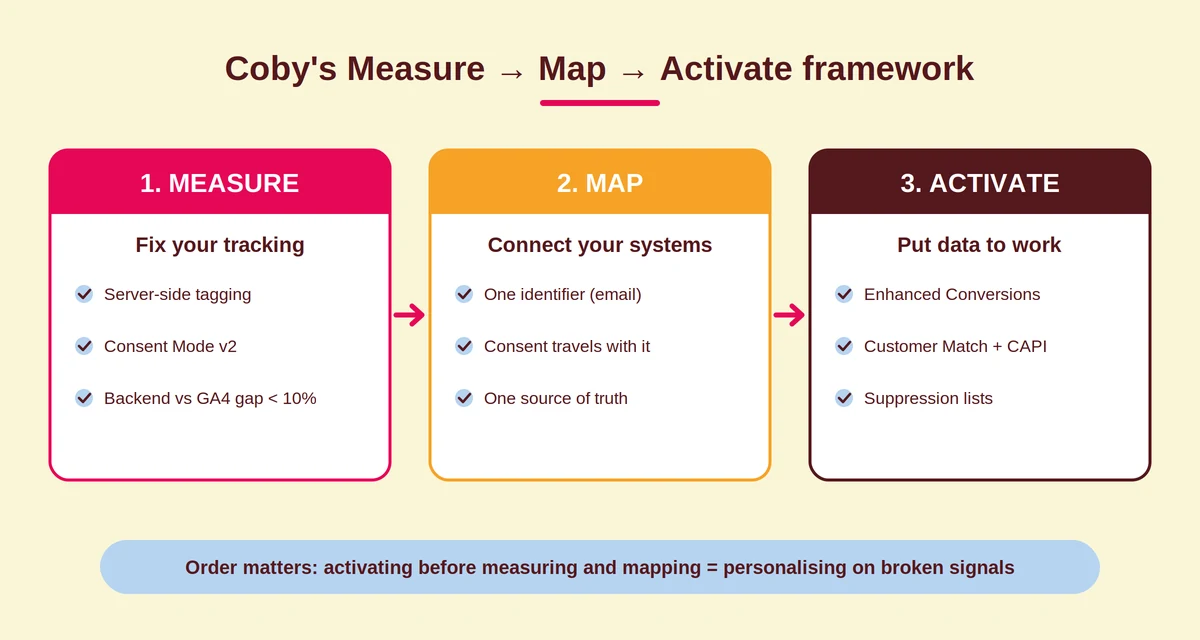
1. Measure. Fix your tracking before anything else. If GA4 misses a chunk of your purchases because of ad blockers and consent rejections, every audience you build afterwards inherits that gap. Server-side tagging closes most of it: see our comparison of server-side tracking tools and our setup guide for server-side GTM with TAGGRS. On Shopify? Start with our GTM custom pixel guide. Conversions that do not match your backend are covered in Google Ads tracking problems.
2. Map. Connect what you measure. Pick one identifier, usually the email address, that exists in your webshop, email tool and CRM, and make sure consent status travels with it. Choose one source of truth for revenue, usually your backend, and stop debating whose dashboard is right. Keep junk out while you are at it: our guide to excluding Cookiebot traffic in GA4 is a five-minute win.
3. Activate. Only now do you upload audiences, switch on Enhanced Conversions and adjust bidding. Activating before measuring and mapping is how brands end up personalising on broken signals, which is worse than not personalising at all.
Five ways to activate first-party data in your campaigns
Once the foundation stands, these five moves put your data to work, roughly in order of effort.
1. Switch on Enhanced Conversions in Google Ads. It sends hashed customer data such as email and phone number along with your conversions, so Google can match them to signed-in accounts and restore conversions your tag missed. Setup details are in Google’s Enhanced Conversions documentation.
2. Upload Customer Match lists. Hashed CRM emails let you target, exclude or bid differently on people who already know you. A list needs at least 1,000 matched members before it serves, and match rates depend on clean, consistent formatting. Automate the refresh, because static uploads decay fast. See Google’s Customer Match guide.
3. Connect the Meta Conversions API. CAPI sends events from your server straight to Meta, alongside the pixel, so iOS users and ad blocker users stop vanishing from your data. Documentation lives at developers.facebook.com. For lookalikes, seed with your best customers rather than everyone, and give Meta volume: a source audience of 1,000 or more models noticeably better than the technical minimum.
4. Build suppression lists. Exclude recent buyers from acquisition campaigns and stop paying to convince people who already converted. Suppression is the most underrated use of first-party data: it costs nothing and frees budget for people who do not know you yet. Where that budget performs best differs per channel; our comparison of Google Ads vs Meta Ads helps you choose.
5. Anchor bidding to lifetime value. If customers entering through one product line keep reordering while another line is one-and-done, set your target ROAS per campaign accordingly instead of treating every first order as equal. A worked example: suppose a first order of 50 euros in category A typically grows to 200 euros within a year, while category B stays at 50. The same tROAS on both quietly starves your best acquisition channel.
Bonus: track micro-conversions such as wishlist adds, size-guide views and filter usage as secondary conversion actions. Do not bid on them, but let them enrich your audiences and diagnostics.
The three-step self-audit
Not sure whether your setup is ready? Check three things, in this order.
- Compare conversions with reality. Put GA4 and ad platform conversions next to your backend orders for the same period. A gap above roughly 10% means: fix tracking first.
- Check your connections. Is Enhanced Conversions active in Google Ads? Is CAPI connected in Meta Events Manager? If either is missing, the algorithms are working with one eye closed.
- Check your lists. Do Customer Match and Custom Audiences refresh automatically from your CRM, or are they a manual upload from months ago? Stale lists mean stale targeting.
If any check fails, that is your starting point. Everything else can wait.
Common mistakes with first-party data
Scaling spend on broken measurement. Broken tracking does not fix itself with more budget. It just misleads you faster.
Uploading once and forgetting. A customer list from January is a different audience by August. Automate refreshes or accept decay.
Personalising into creepy territory. Showing a repeat customer a relevant accessory feels like service. Chasing someone across the internet with the socks they viewed once at 11pm feels like surveillance. Aim for relevance, skip the stalking.
Letting tags ignore consent. If your tags fire regardless of the banner choice, you have a compliance problem and polluted data at the same time. Opted-out users in your audiences make your numbers wrong twice.
Starting with tooling. A customer data platform is not step one. A clean CRM, working tracking and proper consent management get most SMEs further than another subscription.
Waiting for cookies to die. They did not. Meanwhile competitors who built their first-party foundation are already feeding better signals into the same auctions you bid in.
How Coby approaches this
Tracking is not a side dish at Coby, it is where every engagement starts. Marloes built her approach at Google before founding Coby Agency, and the rule has not changed since: no scaling on data we do not trust.
That is why we productised the foundation. Our Data Foundations setup, a one-time 350 to 595 euros depending on your stack, installs server-side tracking, Consent Mode v2, a clean GA4 configuration, Enhanced Conversions and the Meta Conversions API, wired to your webshop and CRM. It is the same base our data and analytics service builds for every ad client.
Does it pay off? For clients like De Eenhoorn and OneMeeting, campaigns run at 1,500% ROAS on exactly this foundation: accurate signals in, confident scaling out. We cannot promise you the same number. We can promise you will finally know your real number.
Curious what is leaking in your setup? Have a look at our services or book a call below.
Conclusion: own your data, then use it
First-party data is not a trend to sit out. It is an asset you already own and are probably wasting. Run the self-audit, fix measurement, map your systems, then activate: Enhanced Conversions, Customer Match, CAPI, suppression and LTV-based bidding. In that order.
Want a second pair of eyes on your setup? Book a free 30-minute call with Marloes and we will map your quickest wins together. Prefer to read on first? The Coby blog has step-by-step guides for most of the topics above.
Frequently asked questions
What is first-party data?
First-party data is information a business collects directly from its own audience through owned channels: website behaviour, purchases, email engagement, app usage and CRM records. Because it comes from a direct relationship, it is more accurate and easier to use compliantly than data bought from third parties.
Is first-party data automatically GDPR-compliant?
No. Collecting data yourself does not create a lawful basis. For marketing you generally need explicit consent, recorded per contact and per purpose. An email address collected for order confirmations may not be used for advertising audiences without separate marketing consent. The Autoriteit Persoonsgegevens actively enforces this in the Netherlands.
How much first-party data do I need before it is useful?
Less than you think. Google Customer Match needs at least 1,000 matched members before a list serves, but suppression lists and email segmentation already work at smaller sizes. Quality and freshness beat volume: a clean list of 2,000 consented buyers outperforms a stale export of 20,000.
Are third-party cookies going away?
No. Google announced in July 2024 that Chrome keeps third-party cookies and confirmed in April 2025 that no separate opt-out prompt is coming. First-party data still matters because Safari, Firefox, iOS privacy settings, ad blockers and consent rejections already block a substantial share of tracking signals.
What is the difference between first-party data and zero-party data?
Zero-party data is the subset a customer shares deliberately: quiz answers, preferences, survey responses. First-party data also includes observed behaviour such as purchases and product views. Zero-party tells you what people say, first-party behaviour shows what they do. You want both.
Written by Marloes Slotboom, founder of Coby Agency. Last updated: August 2026