
Q4 is not like the rest of the year. Decision-makers are under pressure to spend remaining budgets, hit annual targets, and close outstanding deals before January. For B2B companies with the right Q4 B2B marketing strategies in place, that pressure creates opportunity.
The companies that capture a disproportionate share of year-end demand do not do anything dramatically different from the rest of the year. They do it earlier, with more focus, and with better data behind their decisions.
This guide covers the strategies that consistently make the biggest difference for B2B companies in the final quarter, and what to do right now to prepare. It is written for founders and marketing managers at growing B2B companies who run their own campaigns or work with an agency, and who want Q4 to end with pipeline rather than excuses.
Why Q4 demands a different approach
The mechanics of B2B marketing change in Q4. Buyers are more ready to act, but competition increases sharply at the same time.
Advertising auctions get more crowded in November and December. Retail advertisers ramp up for Black Friday and the holidays, and B2B advertisers push to hit annual targets, so cost per click tends to rise across Google Ads and LinkedIn. The exact increase differs per market and per keyword, which is why we would rather have you check your own auction insights than quote a universal percentage. The pattern itself is consistent: the same click costs more in November than it did in September.
If you wait until October to increase your budget, you are paying peak rates to reach an audience you could have built weeks earlier at lower cost.
The other shift is in how decisions get made. Q4 buying committees move faster, but they still involve multiple stakeholders. A strategy that only targets your primary contact, with nothing for the finance lead or the technical evaluator, leaves nearly closed deals on the table. Build content for the whole buying group, not just the person who filled in your form.
Visibility in Q4 is earned before Q4
The companies that win Q4 are usually the ones who stayed active in Q3 while everyone else pulled back.
Brand familiarity matters more than most B2B marketers account for. A prospect who has seen your content throughout the year is far easier to convert in Q4 than one meeting you for the first time in October. The well-known 60/40 guideline from Les Binet and Peter Field, popularised for B2B by the LinkedIn B2B Institute, points the same way: a majority of budget on brand-building that creates future demand, the rest on direct response that captures buyers who are in-market now. Treat it as a direction, not a law. The point is that Q4 is when earlier brand investment pays off.
If you are reading this before Q4 begins, the most productive thing you can do is keep your content output and paid media presence consistent through August and September.
If Q4 has already started, focus your budget on audiences who already know you: retargeting lists, email subscribers, and companies that visited your website recently. On LinkedIn specifically, warm audiences are what keep costs workable in the expensive months. Our guide to LinkedIn Ads for B2B covers how to structure that.
Year-end budgets: sell to buyers in decision mode
Year-end budget cycles create a buying window that does not exist in any other quarter. Many companies must allocate remaining budget before 31 December, not because they want to spend, but because unspent budget disappears or signals to leadership that less is needed next year.
Content that speaks to this dynamic directly performs well. Implementation timelines (“how long does onboarding take?”), ROI calculators, and year-end planning guides attract buyers who are already in decision mode. These are not people researching options. They are people looking for reasons to commit.
For paid campaigns, messaging that connects your service to year-end outcomes (“close the year with clean tracking data”, “start 2027 with campaigns that actually work”) consistently outperforms generic benefit-led copy in Q4.
One practical Google Ads note: if you run a short promotion with a genuinely different conversion rate, such as a year-end offer, Google’s seasonality adjustments let you tell Smart Bidding about the expected change. Google recommends them for short events of roughly one to seven days, not for the whole quarter. Smart Bidding already handles gradual seasonal patterns on its own.
Loyalty: your existing clients are your cheapest Q4 revenue
New business gets the attention, but Q4 is one of the most productive times of year for expanding existing client relationships.
Clients reviewing their annual performance are naturally receptive to conversations about what could work better. A well-timed analysis of their current setup, identifying gaps they have not addressed, gives you a reason to have a commercial conversation that feels helpful rather than pushy.
Retention also protects Q4 revenue in a way new business cannot. A client who churns in October creates a gap that is expensive to fill through acquisition during the most competitive advertising period of the year. Check in proactively with clients whose contracts renew in Q1.
Get sales and marketing aligned before the quarter starts
Misalignment between sales and marketing is most costly in Q4, when speed matters and there is no time to argue about lead quality or attribution.
Before Q4 starts, agree on three things with your sales team: what counts as a qualified lead, what happens to a lead in the first 24 hours, and which content pieces sales should send to prospects who are close to a decision. These sound basic. Most B2B companies have never written them down.
A shared content library that sales can use in direct conversations, with short case studies, comparison documents, and FAQ sheets, removes friction from deals that are already progressing. Marketing creates it once; sales uses it all quarter. If lead quality is the recurring argument, our article on measuring B2B lead generation properly is the place to start.
Keep publishing while competitors go quiet
A recurring pattern in B2B marketing: companies cut content production in Q4 because they assume buyers are distracted. In our experience the opposite is true. B2B decision-makers research actively in Q4, because they are building the case for purchases they need to make before year-end.
Publishing clear, specific content in October and November reaches buyers at exactly the moment they are looking for it. A post on how to evaluate your tracking setup before a new campaign, a guide to what good attribution looks like, a breakdown of what to check when switching agencies: these attract readers who are in consideration mode.
The advantage is that many competitors are quiet in this period, so good Q4 content faces less fresh competition and keeps working into Q1.
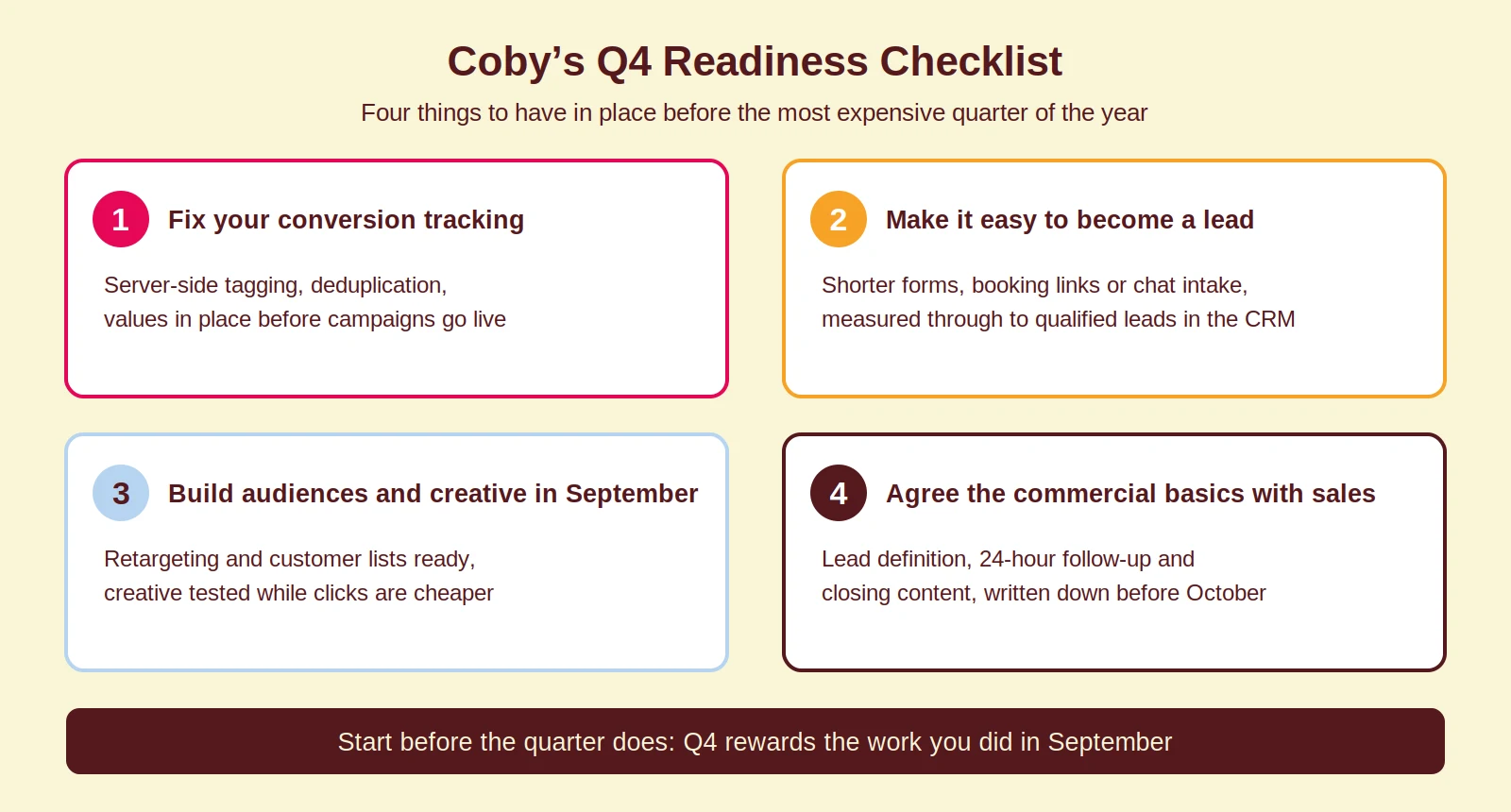
Coby’s Q4 Readiness Checklist
Two technical foundations determine how accurately you can measure what works in Q4. Fix them before your campaigns go live, not after.
1. Fix your conversion tracking first
Browser-based tracking loses data through ad blockers, Safari and Firefox tracking prevention, iOS privacy features, and consent choices. In the most expensive quarter of the year, optimising on a partial picture is optimising on noise.
Server-side tracking recovers a meaningful part of that lost signal, and a basic Google Ads conversion tracking check catches double counting and missing values. If your numbers already look off, start with the eight most common Google Ads tracking problems.
2. Make it easy to become a lead
Standard contact forms convert only a fraction of genuinely interested visitors. Lowering the barrier matters more in Q4 than at any other time, because intent is at its annual peak. Test a shorter form, a direct calendar booking link, or a chat-based intake next to your standard form, and measure which qualified leads each route produces in your CRM.
3. Build your audiences and creative in September
Retargeting lists, customer lists, and tested ad creative cannot be conjured up in November. Run your creative tests while clicks are cheaper, so Q4 budget goes to proven ads.
4. Agree the commercial basics with sales
Lead definition, follow-up speed, and closing content, written down before October. See the section above.
Smarter, not busier
The trap in Q4 is doing more of everything. More campaigns, more content, more emails, more activity across every channel at once.
The companies that finish Q4 strongest usually did less, better. One well-executed campaign targeting a specific audience with a specific offer will consistently outperform five mediocre campaigns running in parallel.
Before Q4 starts, audit what is already working. Which channels drove the most qualified leads in Q2 and Q3? Which content pieces generated pipeline conversations? Put the majority of your Q4 budget behind those, and resist launching something new just because it feels like the season for it.
How Coby approaches this
At Coby Agency we treat Q4 as a measurement problem before it is a budget problem. Extra budget in a broken setup buys you more expensive noise.
So we start every Q4 plan with tracking: are conversions complete, deduplicated, and connected to the CRM, so campaigns optimise on qualified pipeline rather than raw form fills? That tracking-first way of working is the foundation of everything we do.
It is also what makes Q4 budget decisions calm instead of frantic. For one B2B client, fixing the measurement layer and rebuilding campaigns around qualified leads took them from 2 to 3 leads per month to 4 to 5 per week, and that kind of signal makes it obvious where extra Q4 budget should go. If you want a second pair of eyes on your setup before the quarter peaks, our data and analytics team does exactly this, or you can get in touch directly.
Conclusion
Q4 rewards preparation, focus, and clean data. Build your audiences and alignment before the quarter, sell to the year-end buying window once it opens, and let your existing clients and proven campaigns carry the load.
Most of all: make sure you can trust your numbers before you spend at the year’s highest rates. If you want help with that, here is how we run B2B lead generation.
Frequently Asked Questions
When should B2B companies start planning for Q4?
The effective window is July and August. By September, competition is already increasing. Companies that start in summer can build audiences, test creative, and agree commercial messaging before the market gets more expensive.
Should I increase my B2B ad budget in Q4?
Often yes, but only behind campaigns with proven performance and trustworthy tracking. Keep your target cost per qualified lead constant and work backwards from there, rather than picking a fixed percentage increase.
What content works best for B2B lead generation in Q4?
Content that connects to year-end decision-making: ROI calculators, implementation timelines, case studies showing results within one quarter, and direct comparisons. Lead with content that reduces friction for buyers who are ready to act.
How do I measure B2B marketing ROI in Q4 accurately?
Start with solid conversion tracking, server-side where needed, and consistent UTM tagging. Connect ad platform data to your CRM so you can see which campaigns create qualified conversations and closed deals. Pipeline created in Q4 that closes in Q1 still counts as a Q4 outcome.
What is the biggest B2B marketing mistake in Q4?
Starting too late. By October, auctions are more expensive and there is no time left for meaningful tests. The winners built their audiences, tested their creative, and aligned with sales in August and September.
Do seasonality adjustments in Google Ads help in Q4?
Only for short, sharp events such as a limited year-end promotion. Google recommends them for events of about one to seven days. For the quarter as a whole, Smart Bidding adapts on its own as long as your conversion data is accurate.
Written by Marloes Slotboom, founder of Coby Agency. Last updated: September 2026.