
If you’re a founder or director looking for a Google Ads agency, you have a problem: almost everything that makes an agency good is invisible until you’ve signed and started spending. The website looks sharp, the case studies sound impressive, and the sales call is full of confidence. Then month four arrives and you’re staring at a report you don’t understand, wondering who actually touched your account this week.
I’ve audited enough Google Ads accounts to spot the pattern quickly. Healthy-looking dashboards, impressive click-through rates, and then you dig into the conversion tracking and find it’s been firing on page views. Every “conversion” in the account is meaningless. The agency has been optimising toward noise for 18 months and the client has no idea.
This guide gives you a practical way through: the one question to ask before anything else, seven questions that expose a weak agency fast, the red flags in sales pitches, and what honest pricing looks like. By the end you’ll know how to choose a Google Ads agency on evidence rather than charm.
Already signed with an agency and wondering what should happen next? Read the Dutch sibling post Google Ads uitbesteden: wat er echt gebeurt na de overdracht.
The tracking question that comes before everything else
Before you discuss strategy, budget or ad copy, ask this: how do you set up conversion tracking, and who owns that setup? The answer tells you more than any case study.
A good answer involves Google Tag Manager, a clear view of which actions count as conversions (purchases, leads, phone calls), and some mention of how they handle attribution or accuracy, ideally including server-side tracking. A bad answer is vague about the technical side and jumps straight to “we’ll build you great campaigns”.
Here’s why it matters so much. Google’s Smart Bidding strategies learn from your conversion data. If that data is wrong, the algorithm optimises toward the wrong thing. You can have a competent agency running structurally sound campaigns and still haemorrhage budget, because the signal they’re feeding the machine is rubbish. It’s like hiring a brilliant chef and handing them a broken oven thermometer: skill can’t compensate for bad readings.
Most tracking problems are boringly common: duplicate conversions, missing purchase values, tags blocked by consent settings. We’ve written up the most frequent Google Ads tracking problems if you want to check your own account first.
The 7 Questions That Expose a Bad Google Ads Agency
You don’t need to be a Google Ads expert to interview one. These seven questions, asked in order, separate agencies that manage accounts from agencies that manage appearances.
- Who will actually work in my account, and how many other accounts does that person manage? You want a name, not a team page. My rule of thumb after years on the agency side and at Google: once a specialist juggles more than roughly 15 to 20 active accounts, attention gets thin. That’s my opinion, not an industry standard, but ask the question and watch how they answer.
- Do we own our Google Ads account, or do you? Always insist on owning the account, with the agency accessing it through their manager account (MCC). If you can’t take the account with you when you leave, walk away.
- How would you structure campaigns for a business like ours? Listen for separation by product category, margin, intent or geography. One campaign with one budget usually means budget control is an afterthought.
- How do you handle search term reviews and negative keywords? In a well-managed account, someone regularly reviews the actual search terms triggering your ads and cuts irrelevant traffic. It’s unglamorous work that compounds: disciplined negative keyword management steadily pushes budget toward searches that convert. On Display and YouTube the same logic applies to placements, which is why we built a placement excluder script.
- What’s your view on Performance Max? It’s not a bad product, but it needs proper asset groups, brand exclusions and airtight tracking before you let it run. An agency that treats PMax as set-and-forget is worth probing. If they can talk you through advanced Performance Max strategies, that’s a good sign.
- What did the last account you lost teach you? Every agency loses clients. The honest ones can tell you why without blaming the client. The evasive ones have never made a mistake in their lives, apparently.
- What happens in the first 30 days? A well-run onboarding includes a full audit of your existing account, a tracking audit or rebuild, and a 90-day plan tied to your business metrics. If the first month sounds like waiting, keep looking.
Red flags in a sales pitch
The clearest red flag is a guarantee. Google Ads has too many variables for honest guarantees, so anyone promising a specific ROAS before seeing your account, margins and tracking is guessing.
Watch for these as well:
- They can’t explain their fee structure in one sentence. Percentage of spend, flat retainer, performance-based: all fine, as long as you understand exactly what you pay and what it covers. Hidden setup fees and vague “ad spend management” charges deserve hard questions.
- They don’t ask about your margins. An agency optimising for revenue without knowing your product margins might be pushing your budget toward your lowest-margin products. Profit is what pays your bills, not ROAS.
- Their case studies are all impressions and clicks. CTR is a vanity metric if it never connects to revenue. Ask what happened to the client’s revenue, not how many clicks the campaign generated.
- They pitch every channel at once. If you sell B2B services and they open with TikTok, they’re selling what they have, not what you need. For seasonal planning context, see our Q4 B2B marketing strategies.
- A Google Partner badge presented as proof of quality. The Google Partners directory is a useful starting point for your shortlist, and the Partners programme requirements are real. But the badge measures spend and certification, not whether your account gets attention.
What agency size and pricing tell you
Match the size of the agency to the size of your budget, because being someone’s smallest client is expensive. Big-name agencies do genuinely good work for clients spending upwards of roughly €20,000 per month. Below that, you often get a junior account manager, a templated onboarding and quarterly calls where nobody has looked at your account that week.
As rough guidance: if your monthly budget is under about €10,000, look for a smaller agency or boutique setup where you’re a real account, not a line item. The flip side is also true. A one-person Search specialist may not fit if you need Shopping, Performance Max, YouTube and CRM integration working together, or local campaigns across multiple regions. Know what you need before you go shopping.
Pricing itself is a signal. An agency that publishes its rates and keeps contracts flexible has nothing to hide. One that needs three calls before mentioning a number, or locks you into twelve months before proving anything, is negotiating against you from day one. For reference: Coby’s packages start from €795 per month, with no long contracts. That transparency is deliberate. It forces us to earn the next month, every month.
How Coby approaches this
At Coby, tracking comes first, always. Before we touch a bid or an ad, we audit and usually rebuild conversion measurement, because optimising on broken data wastes money at any agency, including ours.
We’re a small senior team with no account-manager layers. You talk directly to the person working in your account. I started Coby after working at Google as an Agency Account Strategist for Benelux and Nordics, which means I spent years looking inside hundreds of agency-managed accounts. Most of what’s in this article comes from seeing the same mistakes on repeat.
Does the approach hold up? For De Eenhoorn and OneMeeting, tight tracking plus focused campaigns delivered a 1,500% ROAS. For a B2B client, leads went from 2 or 3 per month to 4 or 5 per week. And our pricing is public: from €795 per month, minimum recommended ad spend of €1,000 per channel, cancel monthly. You can browse more of our writing on the blog to judge whether we know our stuff before you ever speak to us.
Conclusion: choose on evidence, not charm
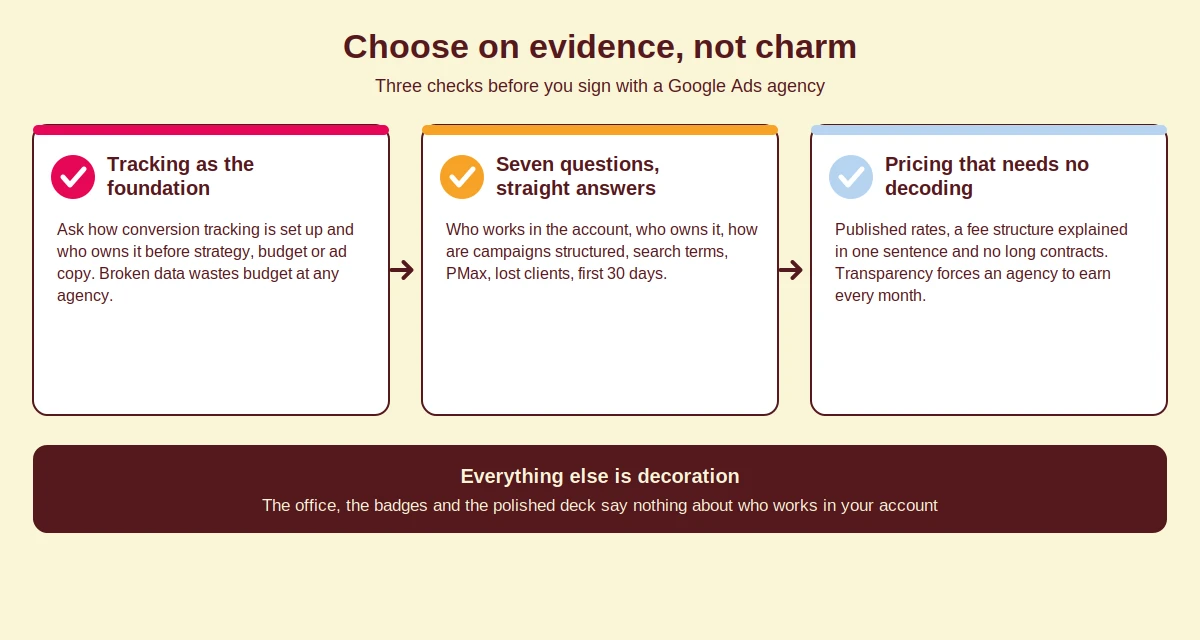
Picking a Google Ads agency comes down to three checks: they treat tracking as the foundation, they answer the seven questions without flinching, and their pricing and contracts don’t need decoding. Everything else, the office, the badges, the polished deck, is decoration.
If you’d like a second opinion on your current setup, or you’re comparing agencies and want a straight answer about whether we’re the right fit, book a free 30-minute call with me. Worst case, you leave with a sharper shortlist.
Frequently asked questions
How much does Google Ads management cost? At Coby, Google Ads management packages start from €795 per month, with no long contracts. We recommend a minimum ad spend of €1,000 per month per channel, because below that there’s usually too little data to optimise properly.
Should I sign a long contract with a Google Ads agency? No. A confident agency will work on a monthly rolling basis after onboarding. Long contracts mainly protect agencies from the consequences of underperforming.
Who should own the Google Ads account, me or the agency? You should always own the account. The agency accesses it through their manager account (MCC), and you keep admin rights. If leaving the agency means losing your account and its history, the setup is wrong.
How long before I see results from a new Google Ads agency? Give it about three months before judging performance. Smart Bidding needs time to learn, especially after tracking or structural changes. The first month should be full of visible audit and setup work, not silence.
Is a Google Partner badge a guarantee of quality? No. The badge confirms certifications, spend thresholds and performance criteria set by Google, which makes it a reasonable shortlisting filter. It says nothing about how much attention your specific account will get.
How do I know if my current agency is underperforming? Ask what they tested in the last 90 days and what it changed. If the answer is vague, and reports lean on clicks and impressions rather than conversions and revenue, your account is likely on autopilot.
Written by Marloes Slotboom, founder of Coby Agency. Last updated: September 2026