
You run a B2B company with somewhere between 10 and 100 people. You’re spending real money on ads every month, the leads are coming in, and yet nobody in the building can tell you with confidence which campaigns actually drive revenue. The dashboard says one thing, the sales team says another, and the gap between them is where your budget quietly leaks.
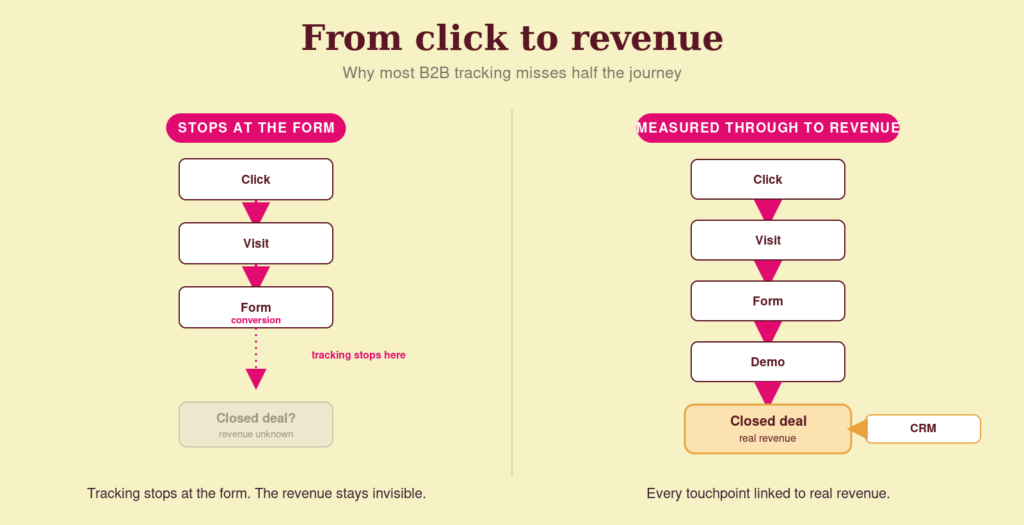
That gap is almost always a tracking problem. When you can’t follow a lead from the first click through to a signed contract, you end up scaling the wrong campaigns and cutting the channels that actually fill your pipeline.
This guide fixes that. You’ll learn what B2B lead generation really involves in 2026, why most companies and agencies get it wrong, and a framework to put tracking before tactics. You’ll also know what B2B lead generation services cost, how to choose a partner, and which questions expose the contact farmers before they bill you. Let’s start where the money leaks.
Key takeaways
- Most B2B lead generation fails on broken attribution. Fix tracking before tactics.
- B2B sales cycles run 6 to 18 months, so short attribution windows miss most of your real revenue.
- Server-side tracking plus CRM revenue attribution shows which sources actually close, so you can optimise for sales-qualified leads instead of form-fills.
- Optimise for close rate by source, not form-fill volume. Quality beats quantity every time.
- Choose a B2B lead generation company by how it tracks revenue, not how many leads it promises.
What B2B lead generation really involves in 2026
B2B lead generation is the work of attracting the right companies, capturing their interest, and tracking them through to revenue. Done properly, it connects every touchpoint, from first click to closed deal.
The reality is messier than most pitches admit. Your buying journey spans 6 to 18 months, touches multiple channels, and involves several decision-makers. Gartner’s research puts the typical buying group for a complex B2B purchase at six to ten decision-makers, each arriving with their own information and priorities.
Someone might discover you through a LinkedIn ad, research on Google, download a whitepaper, then request a demo six weeks later. Each moment matters. Treat lead generation as a single form-fill and you miss the story that drove the sale.
So modern B2B lead generation is really two disciplines stitched together: getting the right people in the funnel, and measuring what happens after they enter it. The second half is where most programmes fall apart.
Why most companies and agencies get it wrong: the attribution gap
Most B2B lead generation fails before a single ad runs, because the tracking underneath it is broken. You cannot optimise what you cannot measure, and you cannot measure properly when your attribution model only sees half the journey.
Here is the pattern, and it is everywhere. A company runs LinkedIn ads for months. The dashboard attributes only a fraction of the revenue the sales team actually closed from those leads, because buyers clicked a LinkedIn ad, browsed the site, then converted through organic search days later. Last-click attribution hands all the credit to Google, the LinkedIn channel looks terrible on paper, and the budget gets cut from what was quietly the best-performing source in the account.
The cause is almost always the same: agencies optimise for cost per lead, mark a form submission as a conversion, and move on. Your real conversion happens months later, after demos and internal sign-off. Optimise on the form-fill and you scale noise. High lead volume with no visibility into what converts to revenue is the single most common problem we see when we take over a B2B account.
Coby’s Tracking-First Lead Gen Framework
The fix is a sequence, not a tactic. Get the data infrastructure right before you spend a euro on campaigns, because there is no point optimising on broken signals. Here are the five steps we run for every B2B client.
1. Server-side tracking
Start with server-side tracking before anything else. Traditional pixel tracking misses chunks of the B2B journey, especially with iOS privacy changes and tightening cookie restrictions.
We implement server-side tracking through Google Tag Manager so conversion data flows from your CRM to your ad platforms, bypassing browser limits. The usual result is a jump in tracked conversions on the same campaigns and the same budget, because the data finally captures what the browser was dropping. Google’s server-side tagging documentation explains the architecture.
2. CRM and revenue attribution
Connect every lead source to actual revenue inside your CRM. If an agency stops tracking at the thank-you page, it is dodging accountability for what happens next.
Switching from volume-based to revenue-based tracking changes the whole picture. Once you can see which traffic closes deals rather than collects email addresses, the campaigns that looked best on cost-per-lead are often not the ones driving revenue. Our tracking and analytics team builds this closed loop so you measure cost per customer, not cost per lead.
3. Behavioural lead scoring
Behaviour is a better lead-scoring signal than demographics. A visitor who hits your pricing page three times and downloads a case study is worth far more than someone who bounces off a blog post.
Behavioural signals predict sales better than job titles alone. Someone who views your integrations page, returns twice, and reads a case study is showing intent that a job title never will. That score feeds straight into your ad platforms, so Google Ads optimises for the conversions most likely to become customers, not the cheapest form-fills.
4. Multi-touch attribution
Weight every touchpoint by its real influence on the sale. Last-click credits the final email; first-click credits the first ad; both are wrong.
A multi-touch model might, for example, give a whitepaper download 15% of the credit, a webinar 25%, and the demo request 60%. The exact weights matter less than the principle: spread credit across the journey and you finally see which channels influence revenue rather than just which one happened to be last. This regularly rehabilitates channels like LinkedIn that look weak under last-click but quietly influence the biggest deals.
5. Sales enablement
Close the loop by feeding everything back to sales. Tag leads by source and behaviour, suppress ads to anyone already in active conversations, and amplify spend on accounts where multiple people are engaging.
For enterprise deals, add account-level measurement. Track anonymous company activity, so when several people from a target account visit your pricing page over two weeks, sales can reach out before a form is filled. That matters most on larger deals, where relationships outweigh form conversions.
The channels that actually work for B2B
B2B buyers don’t live in one channel, so the answer is two or three working together, not six in silos. Start where your customers are, get the tracking right, then expand. Perfect attribution on two channels beats mediocre tracking across six.
Google Ads captures active intent. When someone searches “compliance software”, they have a problem right now. The catch is that B2B sales cycles don’t fit a 30-day window, so a default attribution window will undercount the deals that close months later. Extending the window routinely reveals that a large share of revenue comes from leads older than 90 days. Our search advertising team sets these windows correctly from the start.
Meta works for retargeting and demand generation higher up the funnel, keeping you visible while buyers research. It’s rarely your primary B2B channel, but it’s cheap reinforcement when tied into proper tracking through our paid social service.
LinkedIn is where decision-makers self-identify by job title, company size, and seniority. Connect it to your other channels: anyone who searches on Google but doesn’t convert can see relevant case studies in their LinkedIn feed. LinkedIn’s advertising documentation covers conversion tracking. The point is one cohesive journey, where each touch feeds one tracking system.
How to choose a B2B lead generation company or agency
Choose on how a partner tracks revenue, not how many leads it promises. The right B2B lead generation company starts with your data infrastructure; the wrong one hands you a contact list. Ask these questions and listen carefully to the answers.
How do you track conversions beyond the initial lead capture? The answer must include CRM integration, server-side tracking, and revenue attribution. Vagueness here means vanity metrics.
How do you handle attribution for long sales cycles? If they mention last-click or have no clear method, keep looking. Any serious agency has a specific multi-touch methodology.
What tracking do you implement before launching? It should include server-side tracking, CRM integration, and conversion value optimisation. “We’ll figure out tracking later” wastes months of budget on the wrong signals.
How do you qualify leads beyond form submissions? Look for lead scoring, progressive profiling, and behavioural data. Form-fill volume rarely correlates with revenue.
What’s your average client’s close rate by traffic source? This reveals whether they optimise for quality or volume. Good agencies track close rates and offer benchmarks for your industry.
What access do you need to our CRM and sales process? Legitimate partners need visibility after the handoff. An agency comfortable with minimal data access isn’t serious about results.
One detail worth knowing: a B2B lead generation company and a B2B lead generation agency usually mean the same thing. But specialist B2B lead generation services tend to outperform generalists on pure lead gen, because they’ve built dedicated tools and processes. Full-service SEO and integrated campaigns suit you better when lead gen is one part of a wider plan.
What B2B lead generation actually costs
The honest answer: budget for three separate things, and most people only plan for one. There’s the agency fee, your ad spend, and a one-off tracking setup. Together they decide your real monthly cost.
The agency management fee is what you pay someone to run the programme. For an SME, that’s commonly €1,000 to €3,000 a month, depending on how many channels you run and how much strategy and reporting you need. At Coby, management starts at €1,495 a month for a single channel, with no long contract.
Your ad budget is usually the bigger number, and it goes straight to Google, Meta, or LinkedIn, not to the agency. B2B clicks are expensive, especially on LinkedIn, so a channel needs roughly €1,000 a month minimum to gather enough data to optimise. Most SMEs running B2B lead gen spend between €2,000 and €10,000 a month across channels.
The one-off tracking setup is the part people skip, and it decides whether the rest of the budget works. Server-side tracking, GA4, and CRM integration are a one-time build. At Coby that’s a Data Foundations setup from €595. Spend €5,000 a month on ads with broken tracking and you’re optimising on numbers that aren’t real.
A realistic starting point for an SME is around €2,000 to €4,000 a month all in, weighted toward ad spend as you scale. A founder testing one channel carefully can start lower. A multi-channel programme with a long sales cycle costs more.
How the agency fee is structured also varies. Monthly retainers are the most common and suit ongoing programmes. Per-lead pricing charges for each contact delivered, which rewards volume over quality and tends to fill your CRM with contacts that never close. Performance-based pricing ties part of the fee to closed deals, which only works when the tracking can prove attribution. Whichever model you pick, agree what counts as a qualified lead before launch: company size, budget range, decision-maker involvement, and timeline.
Common mistakes and how to fix them
Most B2B lead generation problems trace back to a handful of recurring errors.
Optimising for form-fills instead of revenue. Fix: tie optimisation to closed deals in your CRM, not thank-you pages.
Last-click attribution on a multi-touch journey. Fix: move to a multi-touch model that weights each touchpoint by real influence.
Short attribution windows. Fix: extend tracking to at least 180 days to capture the revenue that closes after 90 days, which is most of it in B2B.
Lead leakage in the handoff. Leads regularly go missing between the ad platform and the CRM, losing their source attribution on the way. Fix: integrate tracking directly into your CRM so every touchpoint keeps its source.
Slow follow-up. Sometimes a “lead quality problem” is really a sales team taking days to respond, by which point warm leads have gone cold. Fix: automate alerts so leads get a fast first touch.
How Coby approaches this
We do the opposite of most agencies. They launch campaigns on day one. We spend the first two weeks fixing your tracking, because every later decision depends on clean measurement.
That tracking-first approach is our core difference. We start every B2B relationship with a tracking audit that maps your journey from first touch to closed deal and identifies where revenue attribution breaks down. Only then do we touch campaigns.
It works. For OneMeeting Group (the De Eenhoorn venues), we rebuilt the tracking foundation first, then scaled qualified lead flow from two or three a month to four or five a week across six locations, at a 1,500% return on ad spend. Same principle every time: get the data right, then point budget at what actually closes.
The rest follows: server-side tracking built in our tracking and analytics practice, revenue attribution connected to your CRM, behavioural scoring fed back into your ad accounts, and a sales team that finally trusts its leads. Just data you can act on.
Conclusion
You win B2B lead generation by fixing the tracking and attribution that tell you what actually drives revenue, then pointing budget at the channels that fill your pipeline.
Get the data infrastructure right and everything downstream gets easier: better channel decisions, higher-quality leads, and a sales team that closes more from the same spend. Get it wrong and you’ll keep scaling noise.
If you’re spending on ads but unsure what’s working, start with the audit. Book a free lead-gen and tracking audit and we’ll show you where your revenue attribution breaks down.
Frequently asked questions
How much does B2B lead generation cost?
Budget for three things. First, the agency management fee, often €1,000 to €3,000 a month for an SME, or from €1,495 a month at Coby. Second, your ad spend, which is usually the bigger cost and goes to the platforms, from about €1,000 per channel and commonly €2,000 to €10,000 a month for B2B. Third, a one-off tracking setup, from €595 at Coby. A realistic all-in starting point for an SME is roughly €2,000 to €4,000 a month, scaling with ad budget.
What’s the difference between a B2B lead generation company and an agency?
In practice, very little: both generate and qualify leads for B2B businesses, and the terms are used interchangeably. The real distinction is specialist versus full-service. Specialist B2B lead generation services usually outperform on pure lead gen, while full-service agencies suit integrated, multi-channel programmes.
How long should I track B2B lead attribution?
Track for at least 180 days, ideally 12 months. B2B sales cycles average 6 to 18 months, and shorter windows miss most of your real revenue, because a large share of deals close from leads older than 90 days.
What’s the difference between MQLs and SQLs?
Marketing qualified leads show engagement behaviours like content downloads or webinar attendance. Sales qualified leads have genuine buying intent, budget, and authority. Track both, but optimise campaigns on SQL conversion rates so lead quality matches what your sales team can actually close.
Should I track anonymous website visitors for B2B campaigns?
Yes. Many B2B buyers research extensively before filling in a form. Tracking anonymous company-level activity reveals which accounts are evaluating you, so your sales team can reach out proactively instead of waiting for inbound, which matters most on larger deals.
What’s the difference between lead generation and demand generation?
Lead generation captures contact details from prospects ready to buy now. Demand generation builds awareness and interest over time, nurturing prospects with educational content until they’re sales-ready. Most successful B2B programmes combine both: demand generation to build the pipeline, lead generation to capture immediate opportunities.