
If you are a founder or marketing manager comparing B2B lead generation companies, you have probably noticed they all promise the same thing: more qualified leads, delivered monthly, guaranteed. The pitch decks look identical. The difference only shows up months later, when you find out whether those leads became customers or just rows in a spreadsheet.
Here is the uncomfortable pattern we see in audits: the agency reports a falling cost per lead, the sales team complains about lead quality, and nobody can trace a single closed deal back to the campaign that started it. Everyone is measuring something. Nobody is measuring revenue.
This guide gives you a practical way to choose a B2B lead generation company: the reason tracking comes before tactics, the questions that expose a weak partner in one call, the pricing models that align incentives, and the red flags that predict disappointment. By the end you can evaluate any agency on evidence instead of charm.
Key takeaways
- Lead volume is the easiest metric to inflate and the least connected to revenue. Judge a partner on pipeline and closed deals.
- B2B buying journeys are long and involve multiple people, so measurement has to survive months and devices. That is a tracking problem before it is a campaign problem.
- A good B2B lead generation company can explain, in technical detail, how a click becomes a deal in your CRM.
- Pricing that only rewards lead count creates the wrong incentives. Definitions of “qualified” belong in the contract.
What a B2B lead generation company actually does
A B2B lead generation company builds and runs the system that turns strangers into sales conversations: the ads, the content offers, the landing pages, the nurture flows and, if they are any good, the measurement underneath all of it. The channels are familiar, usually a mix of Google Ads, LinkedIn and email.
The difference between providers is rarely the channel mix. It is what they optimise for. An agency that reports on form submissions will happily fill your CRM with students, competitors and people who wanted a free PDF. An agency that optimises for qualified pipeline will send fewer leads and more customers.
That distinction sounds obvious. In practice it is invisible during the sales process, because every agency claims to care about quality. The only way to check is to ask how they measure it, which is where tracking comes in.
Why tracking comes before tactics
The short answer: B2B sales cycles are long and messy, and the default measurement setup only sees the last click. Optimising on that data means optimising on noise.
A typical B2B journey: someone sees your LinkedIn ad, reads a comparison page a week later on another device, forwards it to a colleague, and the colleague fills in your demo form after a Google search. Last-click attribution hands all the credit to Google. The channel that started the deal looks useless, so the budget quietly moves away from what was working.
Signal loss makes this worse. Safari and Firefox restrict cookies, ad blockers strip tags, and consent banners mean a share of visitors is never measured client-side at all. A meaningful slice of your conversions simply goes missing before anyone optimises anything. We explain the mechanics in our guide to server-side tagging, and the most common symptoms in Google Ads tracking problems.
This is why we say tracking comes before tactics. Running lead generation on broken measurement is like hiring a brilliant chef and handing them a broken oven thermometer. Skill cannot compensate for bad readings.
Coby’s Tracking-First Lead Gen Framework
A reliable B2B lead generation setup follows four steps. We run this sequence for every new account, and you can use it to test how a prospective agency plans to work.
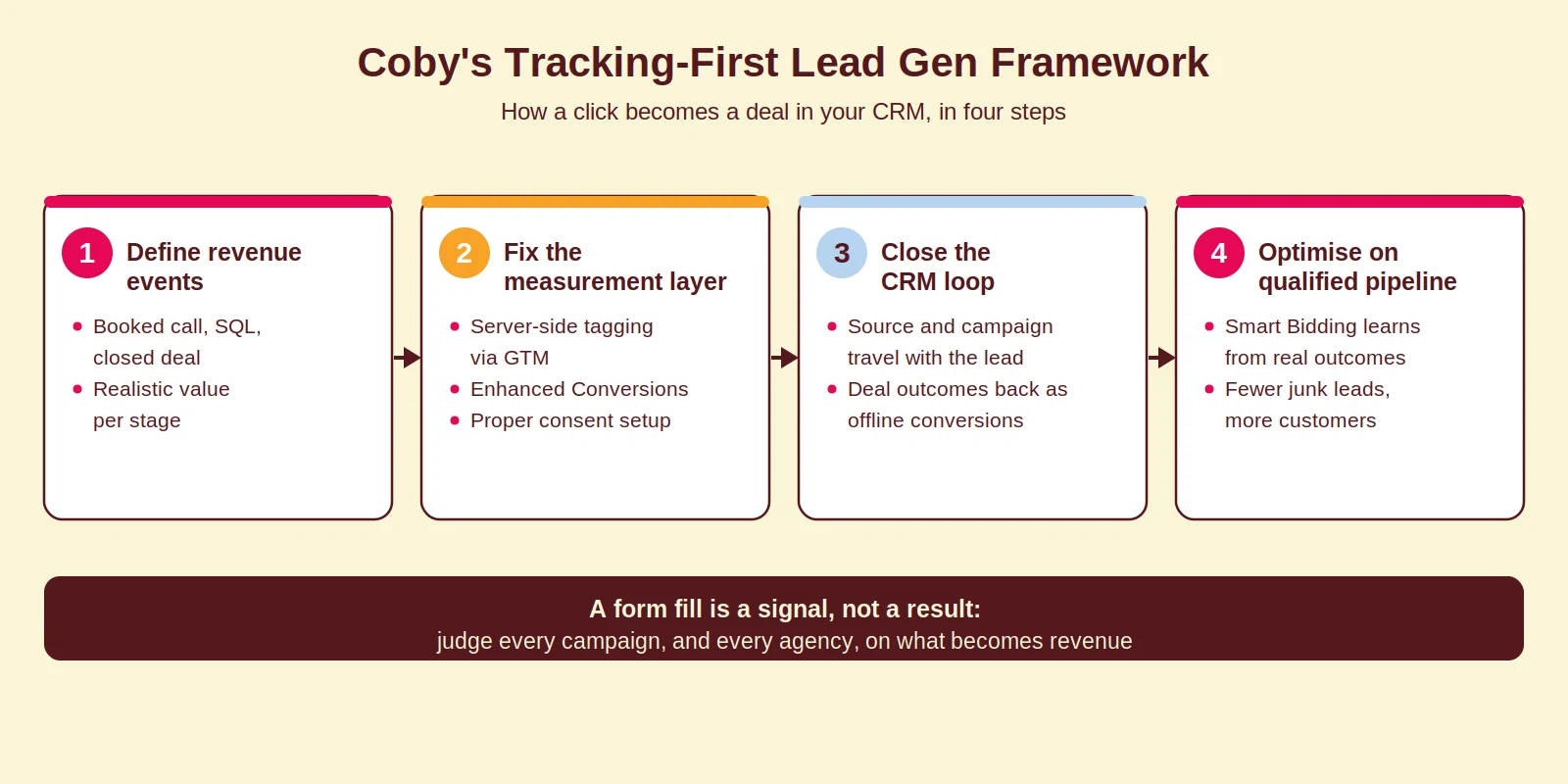
- Define revenue events. Decide what actually counts: a booked call, a qualified opportunity, a closed deal. A form fill is a signal, not a result. Give each stage a realistic value so platforms can tell a brochure request from a demo booking.
- Fix the measurement layer. Server-side tagging via Google Tag Manager, Enhanced Conversions for Google, and consent that is implemented properly. The goal is that platforms learn from as close to complete data as possible.
- Close the CRM loop. Lead source and campaign travel with the lead into the CRM, and deal outcomes travel back to the ad platforms as offline conversions. This is the step most agencies skip, and it is the one that connects spend to revenue.
- Optimise on qualified pipeline. Once outcomes flow back, Smart Bidding can optimise towards leads that behave like your real customers instead of towards whoever fills in forms cheapest.
None of this is exotic technology. It is discipline. The agencies that do it can show you the setup. The agencies that do not will talk about creative instead.
7 questions that expose a weak agency
You do not need to be technical to interview a B2B lead generation company. Ask these in order and listen for specifics.
- How will you track a lead from first click to a closed deal in our CRM? You want UTMs, server-side tagging and offline conversion imports in the answer, not “we send a monthly report”.
- What counts as a qualified lead, and who defines it? The definition should be written down with you, including role, company size and intent signals, before any campaign goes live.
- Which metric do you optimise on after month three? Cost per lead is fine early. If it is still the headline metric in month six, quality is nobody’s job.
- What happens in the first two weeks? A tracking and data audit is the right answer. Launching campaigns on day one means they will optimise on whatever data happens to be there.
- Do we own the ad accounts and the data? Always insist on ownership, with the agency working through partner access.
- How do you handle our sales cycle length? Look for conversion windows and offline imports that match reality. A 90-day sales cycle does not fit a 30-day reporting habit.
- Can you show how you decided to reduce spend somewhere? Good partners cut channels that produce volume without revenue. If every case study is about scaling up, be careful.
An agency that answers all seven with specifics is worth a pilot. An agency that gets defensive at question one has told you everything.
Pricing models and red flags
Most agencies charge a retainer, a price per lead, or a mix. None of these is wrong on its own. The problem is what the model rewards.
Price-per-lead rewards volume, so expect volume. Retainers reward retention, which is fine as long as reporting is honest enough to fire them. Performance elements tied to qualified opportunities or revenue are the healthiest, but they only work when the tracking exists to attribute fairly, which brings you back to the framework above.
Red flags that show up before the contract does: guarantees of specific lead numbers before anyone has seen your data, refusal to work in your CRM, reports built around impressions and clicks, case studies with no measurement story, and pressure to skip the audit phase because “we know what works in your industry”.
One more: an agency that never says no. Lead generation is not the answer to every growth problem. Sometimes the honest advice is to fix the offer, the follow-up speed or the website first.
How Coby approaches this
We are a small team, and we built Coby around one conviction: clean data first, then campaigns. Every B2B engagement starts with a tracking audit, because we refuse to optimise on numbers we do not trust. It is the least glamorous part of the work and the most profitable one.
That approach compounds. For one B2B client, the combination of fixed measurement, tighter qualification and campaigns optimised on real outcomes took lead flow from 2 to 3 leads per month to 4 to 5 per week, without a bigger budget. The channels did not change. The signal did.
Because we work across verticals, from SaaS to manufacturing to healthcare, we also know that channel truths do not transfer. LinkedIn earns its high click prices for one client and wastes them for another. The honest answer is always in your data, which is why we insist the data works first. You can see how we run paid channels on our SEA service page and how we build measurement on our data and analytics page.
Already generating leads but unsure what happens after the handoff? Our guide on tracking B2B leads through to revenue covers the measurement side in depth, and our comparison of Google Ads vs Meta Ads helps with channel choice.
Conclusion
Choosing a B2B lead generation company comes down to one test: can they connect their work to your revenue, and will they build the tracking to prove it? Everything else, channels, creative, pricing, follows from that.
If you want a second opinion on your current setup, we run tracking-first audits that show exactly where leads and attribution leak. Get in touch and we will have a look together.
FAQ
What does a B2B lead generation company do?
It builds and manages the system that turns your target audience into sales conversations: paid campaigns, content offers, landing pages, nurture flows and the measurement that connects those activities to pipeline and revenue.
How much does B2B lead generation cost?
Models vary from monthly retainers to price per lead or per qualified opportunity. The model matters less than the incentive: pricing tied purely to lead volume tends to produce volume, not customers. Agree a written definition of “qualified” before you agree a price.
How long before B2B lead generation shows results?
Expect early signals within 6 to 8 weeks and meaningful pipeline impact after about 3 months, longer for high-value deals with long sales cycles. Be sceptical of anyone promising a full pipeline in month one.
What is the difference between lead generation and demand generation?
Lead generation captures contact details from people who are close to buying. Demand generation builds awareness and interest with people who are not searching yet. Strong B2B programmes combine both and measure them differently.
Should I choose a specialist or a full-service agency?
If lead generation is your main growth constraint, a specialist with deep tracking capability usually wins. If you need brand, content and paid media working together, full-service can make sense, as long as measurement is still someone’s explicit job.
How do I know if the leads are any good?
Track lead-to-opportunity and opportunity-to-close rates per source in your CRM. Good leads progress; bad leads stall after the first call. If your agency cannot report on progression, they are reporting on activity, not quality.
Last updated: August 2026
Written by Marloes Slotboom, founder of Coby Agency