
Google Ads or Meta Ads: which one deserves your budget? It is the question almost every founder and marketing manager asks when they start spending on paid advertising. The honest answer is that it depends on where your customers are in their buying journey. That sounds like a dodge, but there is a clear logic to working it out.
This guide is written for business owners and marketing managers deciding where to invest first, or wondering whether it is time to add a second platform. We break down how each platform works in 2026, what they now have in common, which situations each one suits, and how to combine them once you are ready to scale.
The fundamental difference between Google Ads and Meta Ads
Google Ads captures demand. Meta Ads creates it.
When someone types “performance marketing agency Netherlands” into Google, they are actively looking for a solution. They have intent. Google Ads puts your business in front of that person at exactly the moment they are looking. This is demand capture.
When someone scrolls through Instagram and sees your ad, they were not looking for you. They did not have a specific need in mind when they opened the app. Meta Ads creates the awareness and the desire that may eventually lead them to search for you. This is demand creation.
Neither approach is better. They work on different parts of the same buyer journey. The real question is which part of that journey matters most for your business right now, and which platform addresses it most efficiently.
How Google Ads works in 2026
Google Ads matches your ads to search queries based on keywords, bidding and relevance signals. When someone searches for a term that matches your campaign, your ad is eligible to appear. You pay when they click.
In 2026, Google has moved heavily towards automation. Performance Max campaigns run across Search, YouTube, Display, Discover, Gmail and Maps from a single campaign setup, and since 2025 they come with channel-level reporting, so you can finally see where your budget actually goes. AI Max for Search expands your reach beyond exact keyword matching using improved search term matching, text customisation and final URL expansion. Smart Bidding adjusts bids in real time based on predicted conversion probability.
The practical implication: Google Ads increasingly rewards the quality of your conversion tracking, your landing pages and your audience signals. A poorly configured account with weak tracking will underperform even when it targets the right keywords, because every automated system in the account learns from the data you feed it.
On cost: clicks on Google Search are priced by auction, and high-intent commercial searches are competitive, so a click on Google typically costs more than a click on Meta. Ignore the benchmark tables you find in blog posts. Your own auction insights and search terms report tell you what your market actually costs, and that varies enormously by industry and country.
How Meta Ads works in 2026
Meta Ads runs across Facebook, Instagram, Messenger and the Meta Audience Network. Rather than matching to search queries, Meta uses behavioural data and AI-modelled audiences to decide who sees your ads.
The platform has changed considerably in the last two years. Advantage+ Shopping campaigns were replaced by Advantage+ sales campaigns in the first half of 2025: ad sets are back, and the automation layers for budget, audience and placements are on by default. Meta also removed detailed targeting exclusions in mid-2024, so you can no longer exclude people by interest or demographic; custom audience exclusions and account-level audience controls are what remain.
That makes Meta in 2026 a creative-first platform. Meta’s Andromeda retrieval engine selects your ads from tens of millions of candidates per person, and it rewards genuinely different creative concepts, not five near-identical variations of the same image. Your job is to feed the system strong creative and clean conversion signals, which in practice means the Conversions API alongside the pixel.
On cost: clicks and leads on Meta are usually cheaper than on Google, because you are reaching people who were not actively looking. The trade-off is intent. A Meta lead typically needs more nurturing before it becomes a customer, which is why comparing the two platforms on cost per lead alone is misleading.
Google Ads vs Meta Ads: side-by-side comparison
| Factor | Google Ads | Meta Ads |
|---|---|---|
| How it works | Captures active search intent | Interrupts and creates demand |
| Who sees your ads | People searching for your solution | People matching audience and behaviour signals |
| Creative format | Primarily text-based (Search), feed-based (Shopping) | Visual: video, image, carousel |
| Cost per click | Higher, priced by high-intent auctions | Lower, but with lower intent per click |
| Cost per lead | Higher, but leads convert faster | Lower, but leads need more nurturing |
| Best for | Bottom-of-funnel, high intent | Top-of-funnel, awareness, discovery |
| B2B lead generation | Strong | Moderate (longer consideration) |
| eCommerce | Strong (Shopping, Performance Max) | Strong (Advantage+ sales campaigns) |
| Creative demands | Low (copywriting) | High (video, design) |
| Tracking dependency | High | High |
Which platform to choose: Coby’s Decision Framework
The right platform depends on three factors: where your customers are in their journey, how well-known your solution is, and what resources you have for creative production.
Start with Google Ads if people already search for what you sell
A dentist, a removal company, an accountant, a B2B software tool: these all have people actively searching for them. Google puts you in front of those searches directly. You also need relatively little creative production, because your ads are primarily headlines and descriptions.
Start with Meta Ads if you need to create the demand first
If your product is visual, your brand needs awareness before people will search for it, or you serve a specific audience you can reach through behaviour signals, Meta is usually the better first platform. Fashion, lifestyle products, coaching and consumer services often perform better on Meta first.
Run both when one platform is already profitable
Add the second platform when the first one is profitable and correctly tracked, and when your budget is large enough that splitting it still gives each platform enough conversions to optimise on. Smart Bidding and Advantage+ both learn from conversion volume; if splitting your budget means neither platform gets meaningful data, you are better off concentrating on one.
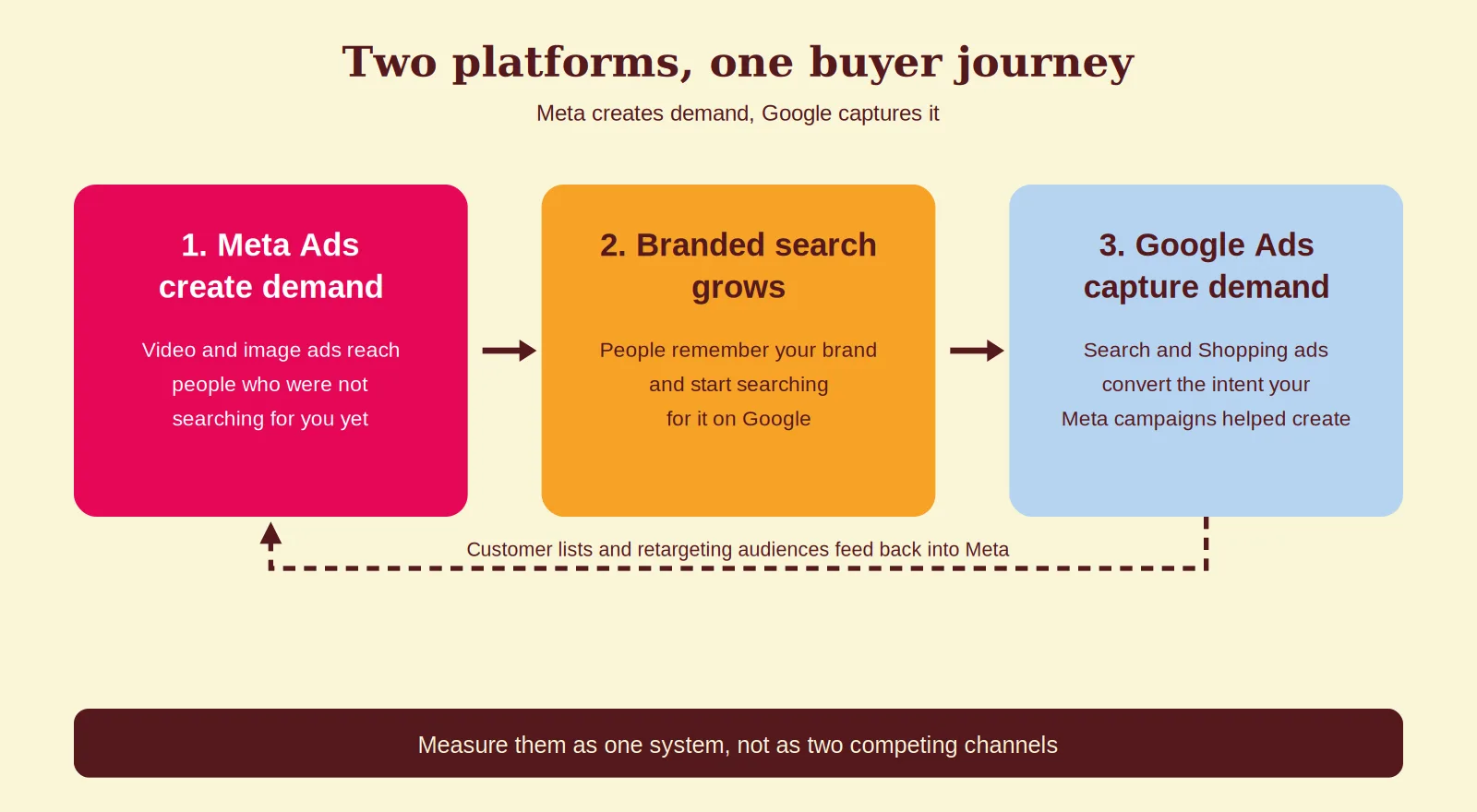
The combination that works best in 2026 is sequential, not parallel: Meta builds awareness and feeds your remarketing audiences, which lifts branded search volume, which Google then captures. The two platforms serve one buyer journey.
What both platforms have in common in 2026
Despite their differences, Google and Meta have converged on the things that decide performance.
Both platforms rely on conversion data to optimise automated campaigns. If your tracking is broken or incomplete, both will underperform. Enhanced Conversions on Google, the Conversions API on Meta and server-side tagging underneath both are no longer optional for serious advertisers. We wrote up the eight Google Ads tracking problems we find in almost every audit, and most of them apply to Meta too.
Both platforms have also reduced manual control in favour of AI optimisation. The advertiser’s job has shifted from micro-managing bids and audiences to providing quality inputs: strong creative, clean conversion signals and well-structured landing pages.
And on both platforms, the biggest performance swings come from offer clarity, creative quality and conversion tracking consistency, not from clever campaign tricks. If you take one thing from this comparison, make it that.
How Coby approaches this
At Coby Agency, we run both platforms for clients across the Netherlands, Germany and the UK through our Google Ads management and performance marketing services, and we start every new client relationship with the same question: which platform are your customers already using to find solutions like yours? For most Dutch B2B companies, that is Google Search first. For most consumer brands, it is Meta first.
We also follow a tracking-first approach: measurement gets fixed before budgets get scaled, on either platform. One of our B2B clients went from 2 to 3 leads per month to 4 to 5 per week after we rebuilt the tracking and concentrated budget on the platform where their buyers actually were, instead of spreading it across both. For e-commerce the same discipline pays off on the shopping side: our client De Eenhoorn reached a 1,500% ROAS with accurate revenue data feeding the campaigns.
The sequencing that works: get Google or Meta to a stable, profitable cost per lead with clean tracking. Then use the audience insights and creative learnings from that platform to inform your expansion onto the second one. The second platform almost always ramps up faster than the first did, because you already understand your customer’s language and behaviour. And if you are choosing an agency to run either platform, ask them how they would sequence it for you; the answer tells you a lot.
Conclusion
Google Ads captures existing demand; Meta Ads creates new demand. Choose based on where your customers are in their journey, prove one platform before adding the second, and treat tracking as the foundation on both. Looking beyond these two? Read Google vs Bing Ads: the differences that matter or our guide to LinkedIn Ads for B2B.
Not sure which platform fits your business, or doubting whether your current setup measures the right things? Get in touch and we will take a look at your situation with you.
Frequently asked questions
Is Google Ads or Meta Ads better for B2B lead generation?
Google Ads generally performs better for B2B lead generation because it reaches people actively searching for a solution. Meta is useful for B2B awareness and retargeting, but it rarely delivers the same quality of initial lead as Google Search.
Why is the cost per lead usually lower on Meta than on Google?
The difference reflects intent. A Google Search lead was actively looking for your solution; a Meta lead responded to an ad they were not looking for and usually needs more nurturing before buying. Compare cost per customer, not cost per lead, when you evaluate the two platforms.
Do I need both platforms to succeed with paid advertising?
No. Many businesses run profitable campaigns on a single platform. Prove one platform first, then expand. Running both before either is working usually means neither gets enough budget or data to optimise properly.
How much budget do I need to test Google Ads or Meta Ads properly?
Enough to generate a meaningful number of conversions per month, because both platforms optimise on conversion data. What that costs depends on your click prices and conversion rate, so work backwards from those numbers rather than from a generic benchmark. If your budget only supports one platform at that level, pick one.
What changed most about both platforms recently?
Both moved further towards AI-driven automation. Meta replaced Advantage+ Shopping with Advantage+ sales campaigns and removed detailed targeting exclusions, making creative quality the main lever. Google launched AI Max for Search and gave Performance Max channel-level reporting. On both platforms, conversion data quality now determines results more than campaign structure does.
Can Meta Ads improve my Google Ads results?
Yes. Meta campaigns build awareness that shows up later as branded search volume, which Google Search then captures at a low cost per click. You can see this effect in your search terms report as branded queries grow while Meta campaigns run.
Written by Marloes Slotboom, founder of Coby Agency. Last updated: September 2026.