 Coby Agency
Plenty of B2B companies run PPC and get exactly what they paid for: clicks. Traffic goes up, form fills trickle in, and three months later sales asks why none of it turned into deals.
The problem is rarely PPC itself. It is running B2B PPC like a webshop: optimising for cheap conversions today, when your actual buyer needs weeks or months, involves several stakeholders, and fills in a form long before they are ready to talk.
This guide is for founders and marketing managers at B2B companies without a big in-house team, who want paid campaigns that produce qualified pipeline rather than a nice-looking click report. It covers how B2B PPC differs from B2C, the framework we use to connect ad spend to revenue, the tools that matter, and the mistakes that quietly burn most budgets.
After reading this, you will be able to:
- Structure campaigns around how B2B buyers actually decide
- Define lead quality in a way both marketing and sales accept
- Feed CRM outcomes back into the ad platforms so they optimise for deals, not form fills
- Spot the expensive mistakes in your current setup
What PPC for B2B lead generation means in 2026
PPC for B2B lead generation is paid advertising, mostly on Google, Microsoft and LinkedIn, designed to capture prospects at different stages of a multi-stakeholder buying process. Where B2C campaigns optimise for an immediate purchase, B2B campaigns optimise for a qualified conversation that sales can develop over weeks or months.
That difference sounds obvious and changes everything. A webshop can judge a campaign on yesterday’s revenue. A B2B company judging a campaign on last week’s form fills is measuring the wrong thing: the form fill is the start of the journey, not the outcome. The outcome lives in your CRM, usually months later.
Modern B2B buyers also do most of their research on their own, comparing suppliers long before they contact anyone. Your campaigns meet them mid-research, which is why intent matters more than reach: a search ad on “marketing automation platform comparison” reaches someone actively deciding; a display ad blasted at a job-title audience mostly reaches someone with a job title.
For where PPC fits in your broader acquisition mix, see our guide on what a B2B lead generation company actually does.
Why B2B PPC matters for revenue
Search captures existing demand. Somewhere in your market, a buyer is typing the problem you solve into Google this week. Ranking organically for those terms takes months; an ad is there tomorrow. That speed is the core argument for PPC in B2B: it is the fastest way to put your offer in front of in-market buyers and to learn which messages they respond to.
The learning half is underrated. Within weeks, your search terms show which problems prospects actually search for, your ad tests show which framing earns the click, and your landing pages show where people hesitate. That feedback sharpens your positioning, your site and even your sales conversations, well beyond the campaigns themselves.
But the revenue case only holds if quality is measured. One client of ours came in generating 2 to 3 leads per month from paid campaigns; after rebuilding tracking and restructuring campaigns around qualified conversions, that became 4 to 5 leads per week. The spend did not change dramatically. What changed was what the campaigns were optimising for.
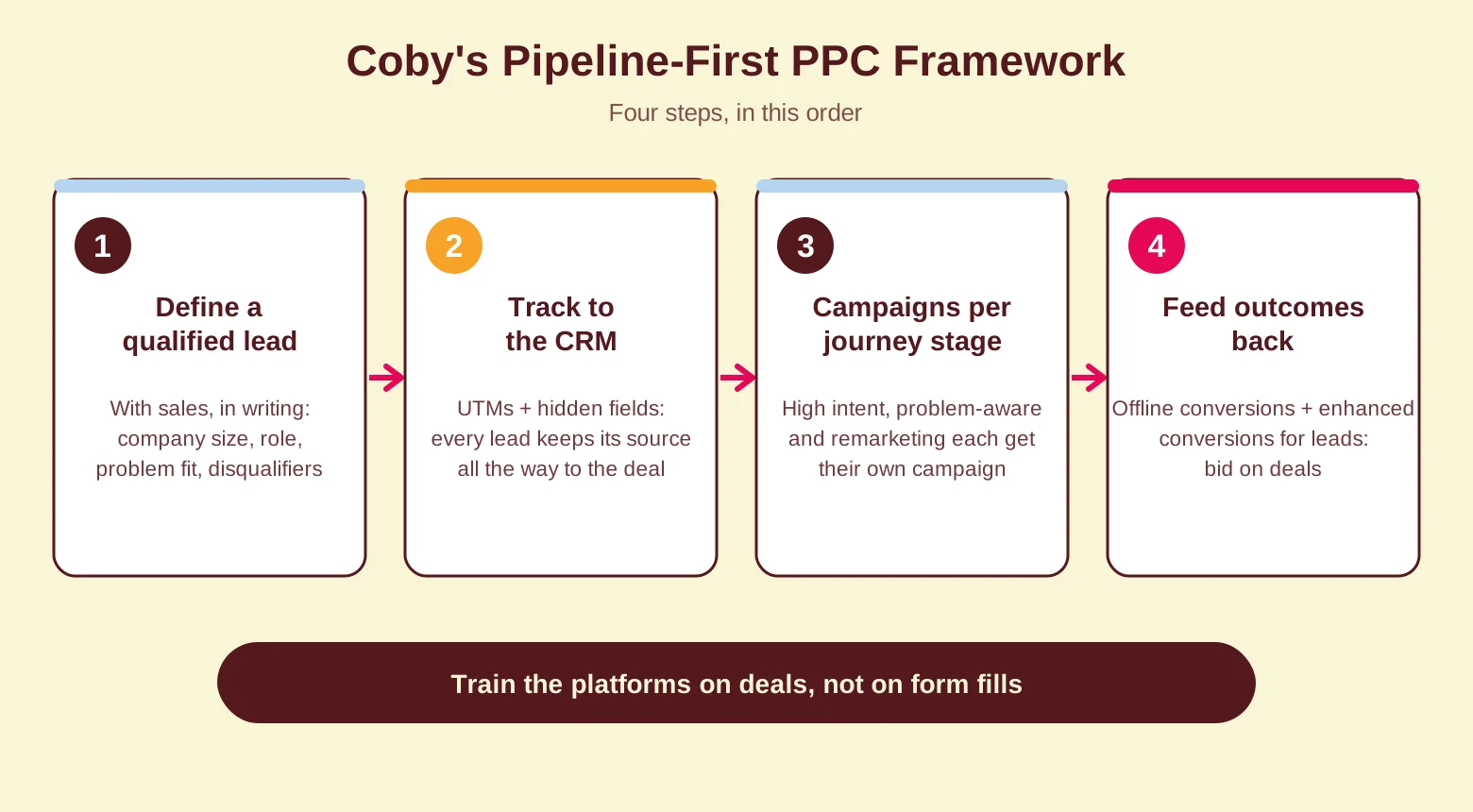
Coby’s Pipeline-First PPC Framework
The framework we use has four steps, and the order matters.
Step 1: Define a qualified lead with sales, in writing
Before any campaign goes live, marketing and sales agree what counts: company size, role, problem fit, and what disqualifies. Without this, marketing celebrates volume while sales ignores the list, and the ad platforms keep being trained on leads nobody wants.
Step 2: Track to the CRM, not to the thank-you page
A conversion pixel on a thank-you page tells you a form was submitted. It cannot tell you the lead was a student, a competitor, or your next best customer. Connect campaigns to your CRM with UTM parameters and hidden form fields, so every lead carries its source with it through the pipeline. Our guide to Google Ads conversion tracking covers the setup in detail, and clean first-party data is what makes the rest of this framework possible.
Step 3: Build campaigns per journey stage
Split your structure by intent, not by product list. High-intent search terms (category, comparison and “provider” queries) get their own campaigns with direct offers. Problem-aware queries get educational content and lighter asks. Remarketing keeps you present during the long middle of the decision, when the buyer is comparing quietly. LinkedIn plays a different role in this mix than search does; we break that down in our LinkedIn Ads for B2B guide and in our comparison of Google Ads vs Meta Ads.
Step 4: Feed outcomes back to the platforms
This is the step most setups skip. When a lead becomes an opportunity or a customer, import that outcome back into Google Ads as an offline conversion; with enhanced conversions for leads, Google matches your CRM data back to the original ad click. Smart Bidding then optimises toward the leads that become deals rather than the ones that are merely cheap. Do this consistently and the platforms slowly learn what your best customer looks like.
Tools and tech stack
You do not need a big stack. You need a connected one.
Google Ads remains the foundation, because search intent is the strongest signal in B2B. Microsoft Advertising is worth adding once Google performs: the same search campaigns, imported, often at lower cost and with a professional audience through the Edge and Windows ecosystem.
LinkedIn Campaign Manager targets by role, company size and industry, which no other platform does as precisely. Treat its self-reported targeting as directional rather than exact, and expect higher costs per click: it earns its place for focused account lists and content promotion, not as your only channel.
A CRM (HubSpot, Pipedrive, Salesforce, it matters less which one) is non-negotiable, because it is where lead quality becomes visible. Add a heatmap or session recording tool like Microsoft Clarity to see where landing pages lose people, and make sure your measurement holds up: attribution in Google Ads now comes down to data-driven attribution or last click, and with consent requirements tightening across the EEA, a tracking-first setup decides how much of your funnel you can actually see.
The one rule: every tool must pass data automatically. The moment lead source lives in a spreadsheet someone updates manually, attribution is fiction.
Common B2B PPC mistakes and how to fix them
Optimising for form fills instead of qualified leads. The platform will happily find you cheap conversions that never become deals. Fix: define quality with sales (step 1) and import offline conversions (step 4), so cheap-but-useless traffic stops being rewarded.
Targeting job titles instead of intent. A campaign aimed at “marketing managers” reaches many people who are not looking for anything. Fix: let search intent lead, and use audience layers to sharpen who sees the high-intent campaigns rather than as a substitute for intent.
Ignoring the search terms report. B2B keywords attract job seekers, students and freebie hunters. Without aggressive negatives (“salary”, “course”, “free”, “template”, competitor brands you refuse to pay for), a large share of budget leaks silently. Fix: review search terms weekly, especially in the first months.
Expecting e-commerce timelines. A B2B deal that takes four months will not show ROI in week three, and judging campaigns on early full-funnel numbers leads to killing good campaigns too early. Fix: judge early campaigns on leading indicators (qualified lead rate, search term quality, landing page engagement) and full ROI on CRM data over quarters.
Sending every click to the homepage. Generic pages break the promise the ad made. Fix: one dedicated landing page per campaign theme, matching the query, with one clear next step.
How Coby approaches B2B PPC
We are a tracking-first agency, and nowhere does that matter more than B2B. Long sales cycles mean the feedback loop between spend and revenue is slow and fragile; if the measurement is broken, you optimise blind for months before anyone notices. So every engagement starts with the plumbing: conversion tracking, CRM connection, consent setup, offline conversion imports.
Then we build the campaign structure around the client’s actual buying journey rather than platform defaults, and we report on pipeline contribution, not click volume. It is the same discipline that took that client from 2 to 3 leads per month to 4 to 5 per week: not a clever hack, but campaigns that were finally being trained on the right outcome.
You talk directly to the people doing the work, and because we have run campaigns from dental practices to sustainable packaging manufacturers, we have seen how differently “a good lead” is defined across industries, and how similar the fix usually is.
Want to know what your current campaigns are really contributing to pipeline? Get in touch for an honest look at your setup, or read how to choose a Google Ads agency if you are comparing options.
Frequently Asked Questions
What is PPC for B2B lead generation?
It is paid advertising on platforms like Google, Microsoft and LinkedIn designed to generate qualified sales conversations for companies that sell to other businesses. It differs from B2C PPC by optimising for lead quality and pipeline over immediate, high-volume conversions.
Which platform is best for B2B PPC, Google or LinkedIn?
Start with Google Ads, because search captures buyers who are actively looking. LinkedIn adds precise role and company targeting at higher cost per click, which works best for focused account lists and content promotion. Most mature B2B setups use both for different jobs.
How long before B2B PPC shows results?
Traffic and first leads typically appear within weeks, but meaningful pipeline impact follows your sales cycle, often a quarter or more. Judge early campaigns on lead quality signals and search term relevance, not on closed revenue in month one.
How do I measure PPC ROI with a long sales cycle?
Connect campaigns to your CRM so every lead keeps its source, then import outcomes (opportunities, customers) back into the ad platforms as offline conversions. That lets you evaluate campaigns on pipeline and revenue contribution rather than cost per form fill.
What is a realistic B2B PPC budget?
Enough to gather decent data in your market: in competitive B2B niches, cost per click is high and a minimal budget produces too few clicks to learn from. Rather than a universal number, work back from your average deal value and what a qualified lead is worth to you.
Should B2B campaigns use Smart Bidding?
Yes, once conversion tracking is trustworthy and ideally fed with offline conversion data. Smart Bidding optimises toward whatever you define as a conversion, which is precisely why the definition and the data quality have to come first.
Last updated: October 2026
Written by Marloes Slotboom, founder of Coby Agency