
A pattern we keep running into during account audits: Performance Max and Demand Gen running side by side, overlapping on the same audiences, pulling from the same creative assets, and reporting into conversion actions that fire twice. Nobody can say which campaign is actually doing anything.
That is not a campaign strategy problem. It is a tracking problem that makes both campaign types look worse than they are, and it is more common than most agencies will admit.
If you run marketing for a growing business and you are weighing performance max vs demand gen, this guide gives you a clean way to decide. Once tracking is in order, the question becomes surprisingly easy to answer.
After reading this, you will be able to:
- Tell the difference between what PMax and Demand Gen actually optimise for, not just what Google says they do
- Choose the right campaign type for your budget level and funnel stage
- Know which metrics to hold each campaign type accountable to
- Run both at the same time without them cannibalising each other
What Google is actually doing differently with each campaign type
Performance Max runs across all of Google’s inventory from one campaign: Search, Shopping, Display, YouTube, Gmail, Discover and Maps. You give it a budget, a conversion goal and creative assets, and automated bidding decides where your ads show and to whom.
For years, the trade-off was opacity. That has improved. Google has rolled out channel-level reporting, search terms insights and campaign-level negative keywords for PMax, so you can now see where budget goes per channel and block irrelevant queries. See Google’s Performance Max documentation for the current feature set. It is still an automation-first campaign type, but no longer a black box.
Demand Gen is narrower and more controllable. It replaced Discovery campaigns in early 2024 and runs on YouTube (including Shorts), Discover, Gmail and, since 2025, the Google Display Network, with channel controls that let you pick which of those placements you use. Google has since folded Video Action campaigns into Demand Gen, and standalone Display campaigns are now being absorbed as well: that migration was announced in May 2026, a phased migration tool has been running since June 2026, and remaining Display campaigns will be migrated automatically over the coming period. That tells you where this campaign type sits in Google’s plans. The key difference: you get actual audience targeting. Customer lists, lookalike segments, interest audiences, and placement choices. Google’s Demand Gen documentation covers the details.
The practical split we use with clients: PMax is a conversion harvester. Demand Gen is an attention builder. They are not interchangeable, and running both without a clear division of labour is how you end up with the attribution mess described above.
When PMax is the right call
PMax performs best when three things are true: your conversion data is clean, there is enough volume for the algorithm to learn from, and you have a product catalogue that benefits from Shopping placements.
For an eCommerce brand with a broad catalogue and a steady flow of purchases, PMax can genuinely find demand you would not have reached through manually structured campaigns. If your shopping feed is in good shape, it has more signals to work with.
Volume matters. As a rule of thumb, we want to see a few dozen conversions per month feeding the campaign’s optimisation goal before letting PMax loose. Below that, the algorithm is essentially guessing. And PMax trained on bad conversion data will confidently optimise toward the wrong thing, which is why our work always starts with verifying that conversion tracking is accurate.
One more thing: PMax tends to cannibalise brand search. Without brand exclusions, it claims credit for people who were already searching your name, which inflates its reported ROAS. Set up brand exclusions from day one. Our guide to advanced Performance Max strategies goes deeper on this.
When Demand Gen earns its place
Demand Gen is for the part of your audience that has not decided to buy yet and has not searched for you. That makes it harder to measure directly against revenue, which is why many brands skip it entirely and then wonder why their PMax performance slowly deteriorates as the top of the funnel dries up.
It works particularly well in three situations.
- You have a genuine creative asset. A video that explains the product well, a strong before and after, something with stopping power on YouTube. Demand Gen with weak creative is just expensive awareness you cannot prove.
- You have a customer list worth using as a lookalike seed. Ideally your best buyers rather than all purchasers.
- Your product has a longer consideration cycle. Furniture, B2B software, higher-ticket services. Nurturing someone for weeks before they convert matches how those buying decisions actually work.
We covered the campaign type itself in our Demand Gen campaigns guide; this post is about choosing between the two.
Coby’s Division of Labour setup for running both
This is where most accounts go wrong. The accounts we audit that run both campaign types usually have no audience exclusions between them, no budget logic that reflects their different roles, and a single conversion action feeding both. The result: two campaigns bidding against each other in overlapping auctions, and neither with clean data to learn from.
The setup we prefer is a simple division of labour:
- PMax owns the bottom of the funnel, with Shopping and Search inventory doing the heavy lifting.
- Demand Gen targets cold audiences that are explicitly kept apart from PMax through audience signals and customer match lists.
- Each campaign reports into conversion actions that are deduplicated and correctly windowed, so attribution reflects reality.
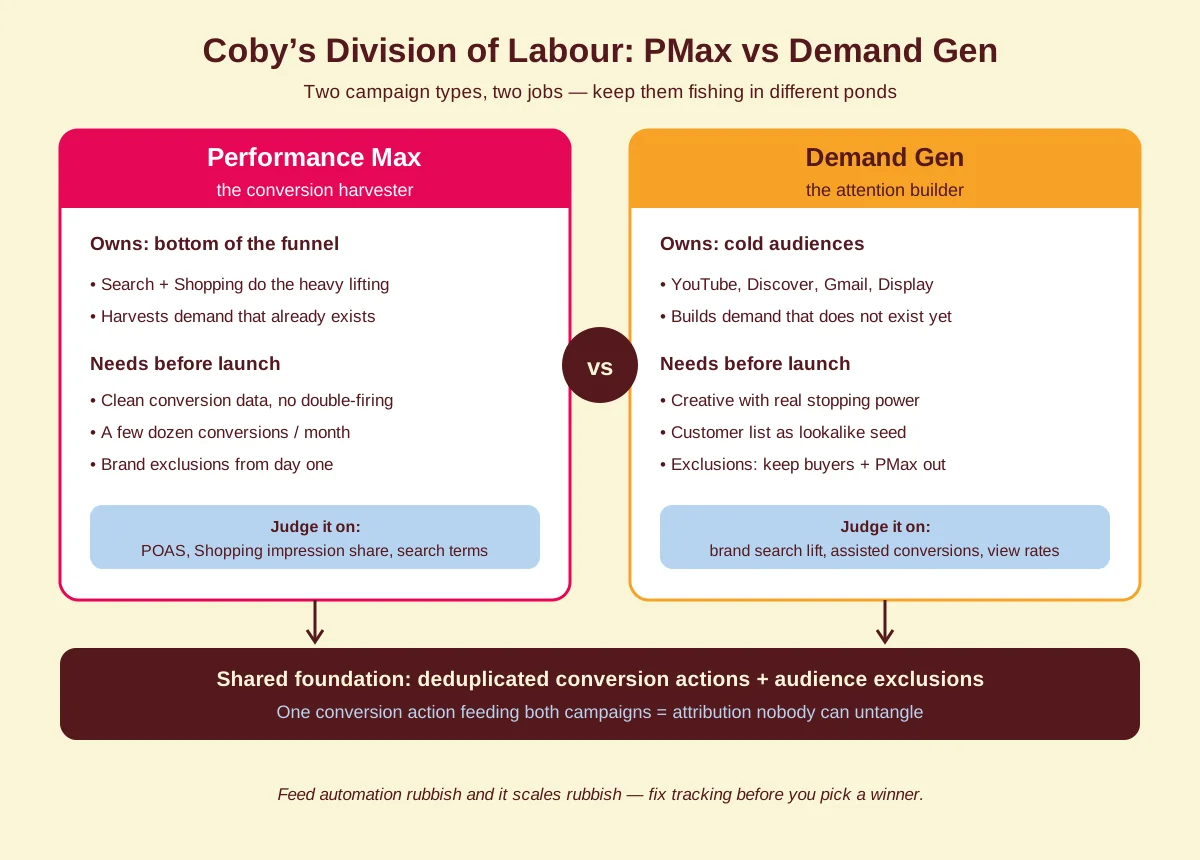
The two campaigns should be fishing in different ponds. Clean tracking is the precondition, because if your events fire twice or your conversion window is set too wide, the attribution picture is wrong before optimisation even starts. This is exactly why we treat tracking as the first thing to fix in any account.
Budget split depends on your situation. For a brand with strong organic search volume and healthy direct traffic, a modest, sustained share of budget on Demand Gen as an awareness layer makes sense. For a brand still building search volume, start with PMax until conversion data is stable, then introduce Demand Gen as a second phase.
The metrics question nobody answers clearly
Most PMax vs Demand Gen content dodges the question of what to actually measure. Here is our answer.
For PMax, track profit rather than revenue where you can. POAS beats ROAS because revenue without margin is a vanity metric. Alongside that: impression share on Shopping, the search terms insights, and asset group performance, so you can spot asset groups that pull budget without contributing.
For Demand Gen, direct ROAS is the wrong lens. Look at video view rates, assisted conversions in GA4, and movement in branded search volume over the campaign period. Brand search lift is the clearest proxy for whether Demand Gen is building awareness or just burning budget on impressions nobody acts on.
If you judge Demand Gen on the same last-click logic you use for Shopping, it will always look underpowered. It is working a different part of the purchase journey, so hold it to different numbers.
How Coby approaches this
We are a tracking-first agency, and this comparison is where that pays off. Before we touch campaign settings, we check for duplicate conversion firing, conversion window mismatches and audience overlap. Only then do we split roles between PMax and Demand Gen, because both campaign types are automation built on top of your data. Feed them rubbish and they scale rubbish, quickly.
That audit-before-optimise order comes from running campaigns across very different verticals, from dental practices to sustainable packaging. The campaign mix changes per business; the requirement for clean data never does. If you want an honest look at how your PMax and Demand Gen campaigns are really attributing, that is what our data and analytics service exists for, alongside hands-on Google Ads management.
The short version
PMax harvests existing demand across all of Google’s inventory. Demand Gen builds new demand on YouTube, Discover, Gmail and Display. Choose PMax first if you need conversions and have the data volume; add Demand Gen when the top of your funnel needs feeding and you have creative worth showing. And fix tracking before either, because automated campaigns are only as good as the data they learn from.
Want a second pair of eyes on your setup? Get in touch for an audit.
Frequently Asked Questions
Is Performance Max or Demand Gen better for eCommerce?
For most eCommerce accounts, PMax is better for direct purchase conversions because of Shopping inventory and the volume of commercial-intent signals Google can use. Demand Gen earns its place once PMax is stable and you want to grow the top of the funnel.
Did Demand Gen replace Discovery campaigns?
Yes. Demand Gen replaced Discovery campaigns in early 2024, adding YouTube and Shorts placements plus stronger audience controls. Google has since also folded Video Action campaigns into Demand Gen, and standalone Display campaigns are currently being migrated into Demand Gen as well, in a phased rollout that started in mid-2026.
Can PMax and Demand Gen run at the same time without cannibalising each other?
Yes, but only if you actively manage audience exclusions. Keep Demand Gen pointed at cold audiences, keep your existing customers and recent purchasers out of it, and give each campaign clean, deduplicated conversion data. Without that, both campaigns bid on the same users and attribution becomes impossible to untangle.
How many conversions do I need before Performance Max is worth running?
There is no official minimum, but automated bidding learns from conversion volume. As a rule of thumb, aim for at least a few dozen conversions a month feeding the campaign goal. Below that, a simpler campaign structure usually performs more predictably.
How do I measure Demand Gen if it does not drive direct conversions?
Look at assisted conversions in GA4, changes in branded search volume during and after the campaign, and video view rates. If branded searches are flat and assisted conversions show no lift, the creative or the audience needs work.
What tracking setup do I need before running either campaign type?
At minimum: accurate conversion actions that do not double-fire, a sensible conversion window, and customer lists uploaded for exclusions. Server-side tagging helps make that data more complete and reliable.
Last updated: October 2026
Written by Marloes Slotboom, founder of Coby Agency