
The first quarter of the year is always framed as a fresh start. New budgets, new targets, renewed optimism. In practice, Q1 usually becomes a continuation of whatever was running in Q4, only with slightly adjusted budgets and new dates in the account.
We wrote these digital marketing tips ahead of Q1 2026, but the pattern repeats every year, so the playbook below is written to keep working long after that quarter. It is for marketers running Google Ads and Meta Ads themselves, at companies without a big in-house team. The common thread through all five tips is signal quality: the clearer the data you feed the platforms, the better they perform for you.
1. Rethink intent, not just keywords
Many accounts still treat keyword lists as static assets. They are built once, expanded occasionally and then left to optimise themselves. At the start of a new quarter, that mindset holds you back, especially in Google Search.
User intent is fragmenting. People search with more context, more qualifiers and more uncertainty. Smart Bidding can handle that, but only if your account structure and signals are clean. In B2B, that means separating exploratory searches from solution-aware searches instead of grouping them in one campaign. In B2C, it means distinguishing inspiration-driven searches from urgency-driven ones, even when the product is the same.
Something similar applies on Meta, where the ranking systems have moved far beyond interests and demographics. Since late 2024 Meta’s ad retrieval runs on Andromeda, a machine learning retrieval engine that selects from tens of millions of candidate ads per person. The practical lesson from Meta’s own engineering write-up: the system rewards genuinely different creative concepts, and near-duplicates add little. Mixing casual browsers and ready-to-buy visitors in one ad set with one message gives it conflicting signals, and performance flattens even when budgets rise.
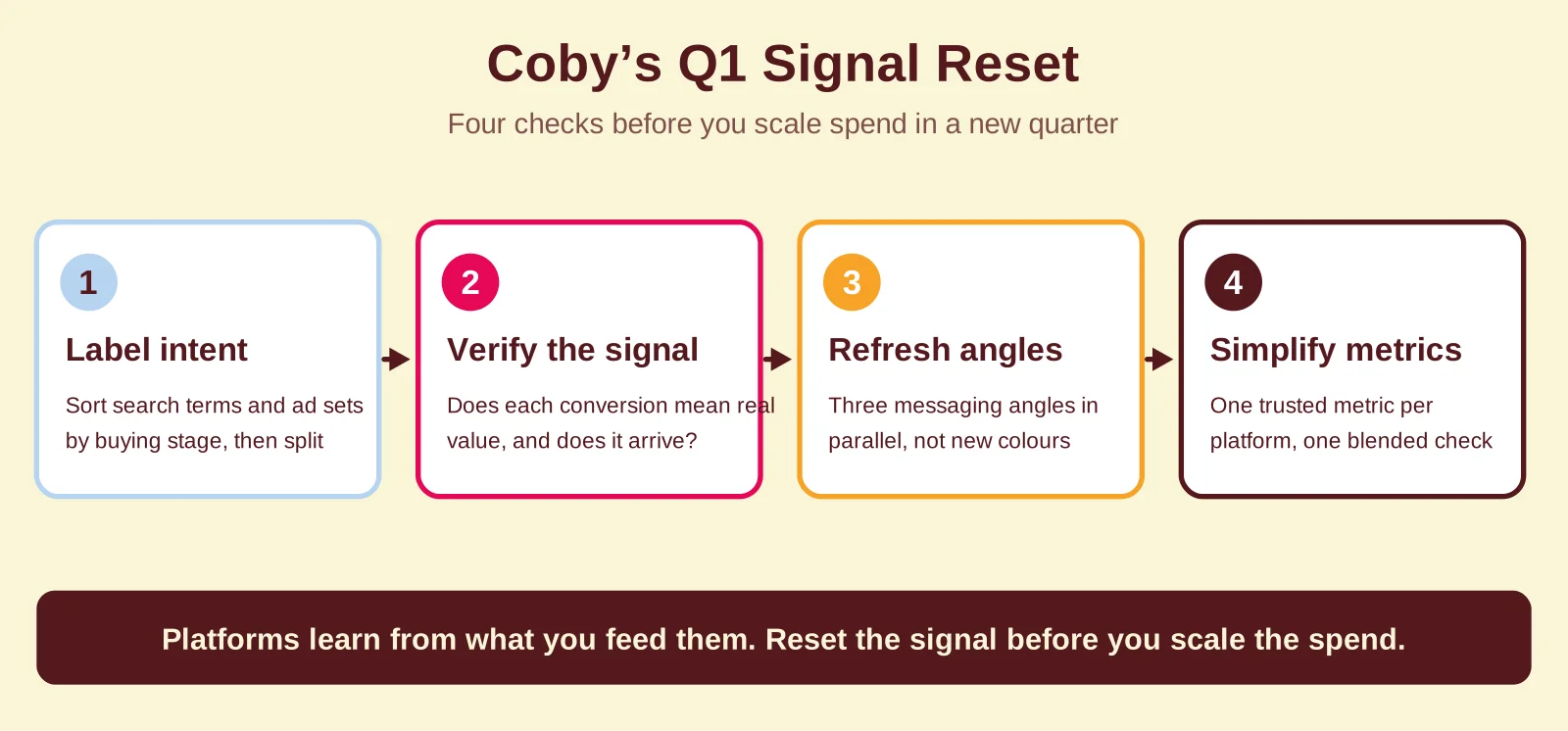
Two actions for the start of the quarter. First, pull your top search terms from the last six months and label them by intent. Second, find the Meta ad sets where different intent levels share one creative, and split at least one campaign so message, creative and landing page match a single intent stage.
2. Stop trusting automation without feeding it properly
Automation is no longer the future; it is the default. But many marketers still treat automated bidding and campaign types as black boxes. That is riskiest at the start of a year, when algorithms are recalibrating against fresh data.
In Google Ads, value-based and target-based bidding depend on conversion quality, not just volume. If half the leads you optimise towards are unqualified, the system learns the wrong patterns. Google’s own guidance for Target ROAS, for example, recommends at least 15 conversions in the past 30 days for Search and Shopping; below that, the data is too thin to steer on.
Signal completeness matters just as much as signal volume. Browser-based tracking alone loses events to tracking prevention and consent choices, which is why server-side tagging has become the standard way to keep conversion events reaching the platforms reliably. Without it, automation still runs, but it learns from incomplete data.
Customer lists play a bigger role than many advertisers realise. Google and Meta both use first-party audiences not just for targeting but as signals for what a valuable user looks like. Outdated, tiny or unsegmented lists give the systems less to work with.
So before the quarter starts in earnest: review your primary conversion actions and ask whether each one represents real business value. Check that those events arrive reliably, following the setup in our Google Ads conversion tracking guide. Then refresh your customer lists and segment them by value or lifecycle stage. B2B teams should align this with sales and CRM data; B2C teams with repeat purchase and margin data.
3. Creative fatigue is faster than you think
One of the most underestimated risks going into a new quarter is creative fatigue, particularly on Meta. Audiences see more ads than ever, and even strong creatives lose impact quickly.
Static images with generic messaging struggle unless they are extremely distinctive, and video does not automatically solve it. What matters is variation in angle, not just format. A B2C brand can rotate between usage moments and objections; a B2B advertiser between problem framing, outcome framing and credibility framing. That is exactly the concept diversity Meta’s Andromeda-era systems reward.
Map at least three messaging angles for your core offer and brief creatives for each one. Launch them in parallel, review after two weeks rather than two months, pause losers decisively, and iterate winners with a new angle rather than a new colour. For the fatigue signals worth watching (frequency, first-time impression ratio, cost per 1,000 accounts reached), see our paid social trends guide.
4. Budget pacing matters more in Q1 than in Q4
In Q4, aggressive spending often makes sense because demand spikes. Q1 is different: demand is more unpredictable and intent is weaker, especially in the first weeks of January. We covered the Q4 side in our Q4 B2B marketing guide; the start of the year asks for the opposite discipline.
Many advertisers overspend early, pushing algorithms to find volume before signal quality is established. On both Google and Meta, that can lock campaigns into inefficient learning patterns that take months to correct. Note that Google’s seasonality adjustments are designed for short events of roughly one to seven days, not for easing a whole quarter in; January is a pacing job, not a toggle.
Set weekly budget thresholds instead of monthly ones, especially for new or restructured campaigns. Monitor downstream quality indicators such as lead-to-sale rate or average order value alongside cost per result. If performance drops, reduce spend slightly rather than forcing the platform to learn faster.
5. Measurement needs to be boring and reliable again
With constant changes to privacy rules, attribution and platform reporting, measurement has become noisy. Many dashboards look impressive and clarify nothing.
The marketers who win a quarter are the ones who simplify. For B2B, that means accepting longer feedback loops and blending data sources. For B2C, it means understanding the limits of platform-reported ROAS and validating it against backend revenue. Platform dashboards each claim their own version of the truth, which is why we recommend one neutral layer on top; our guide to cross-channel measurement explains how to build it.
A blended efficiency metric such as MER (total revenue divided by total marketing spend) deserves attention here. You will find blogs quoting universal MER benchmarks; treat those with suspicion, because a healthy ratio depends entirely on your margins, growth stage and sales cycle. Calculate your own floor from margin data instead, or go a step further and optimise on profit directly, as we describe in our POAS vs ROAS guide. MER is not a replacement for platform data, but when platform dashboards look strong while MER deteriorates, efficiency is leaking somewhere in the funnel.
Pick one primary success metric per platform that you trust enough to base decisions on, plus one overarching efficiency metric to keep perspective. Document why you trust them and what their limits are, share that internally, and resist optimising towards five metrics at once.
How Coby approaches this
Every tip above leans on the same foundation: measurement you can trust. That is why our quarter-start work with clients begins at the tracking layer, not the campaign settings. It is the core of our tracking-first approach to performance marketing.
The order pays off. For one B2B client, fixing conversion definitions and the measurement layer before touching campaigns took lead flow from 2 to 3 leads per month to 4 to 5 per week. The campaigns did not get smarter; the signals they learned from did.
If you want a second pair of eyes on your setup before the next quarter starts, our data and analytics team can help, and a free audit will show you where the gaps are.
Use Q1 to build, not just to perform
The first quarter is not about chasing new features or forcing quick wins. It is about making clearer choices while there is still room to adjust. Marketers who treat Q1 as a testing ground rather than a scaled-down Q4 are better positioned for the rest of the year.
Across Google Ads and Meta Ads the common thread stays the same: clear intent, reliable tracking, focused creatives, controlled budgets and simple measurement all feed platforms that can actually learn what good performance looks like. Stop optimising for activity, start optimising for understanding, and the start of the year becomes an advantage instead of a slow patch. Questions about your own setup? Get in touch.
Frequently asked questions
What is the single most important move to improve performance in Q1?
Make your signals clearer. Clean intent separation, reliable conversion tracking and one primary success metric per platform help both Google and Meta learn faster and more accurately.
How do I rethink intent in a practical way?
Label your top search terms by intent, such as exploratory versus solution-aware or inspiration versus urgency. Then give each intent level its own campaign or ad set with matching creative, copy and landing page.
What should I check first if automation performance drops in January?
Start with conversion quality and tracking reliability. If your conversion action does not represent real business value, or events arrive inconsistently, automated bidding optimises towards the wrong outcomes.
How can I reduce creative fatigue without redesigning everything?
Rotate messaging angles, not just formats. Launch several angles in parallel, review after two weeks, pause losers quickly and iterate winners with a fresh angle rather than cosmetic changes.
What is a simple way to pace budgets in Q1?
Use weekly thresholds instead of monthly targets, especially on new or restructured campaigns. Watch downstream quality such as lead-to-sale rate and average order value, and make small spend reductions when efficiency slips.
Is there a good MER benchmark to aim for?
No universal one. A healthy MER depends on your margins, growth stage and sales cycle, so calculate your own floor from margin data. Use MER as a grounding metric next to platform reporting, not as a target copied from a blog.
Written by Marloes Slotboom, founder of Coby Agency
Last updated: October 2026