
Open your Google Ads dashboard and Meta Ads Manager side by side, add up the conversions, and you will often count more sales than your webshop actually made. Both platforms are claiming the same customers.
That is the problem cross-channel measurement solves. If you run an SME that advertises on more than one channel, whether that is Google and Meta, or search plus LinkedIn plus email, you need one version of the truth that sits above the platforms. Otherwise every budget discussion turns into Google’s dashboard arguing with Meta’s.
This guide explains how cross-channel measurement works in 2026, which parts of the old advice no longer apply, and the framework we use at Coby to make budget decisions on numbers we actually trust.
What cross-channel measurement means in 2026
Cross-channel measurement means judging all your marketing channels against one shared data layer, instead of letting each platform grade its own homework.
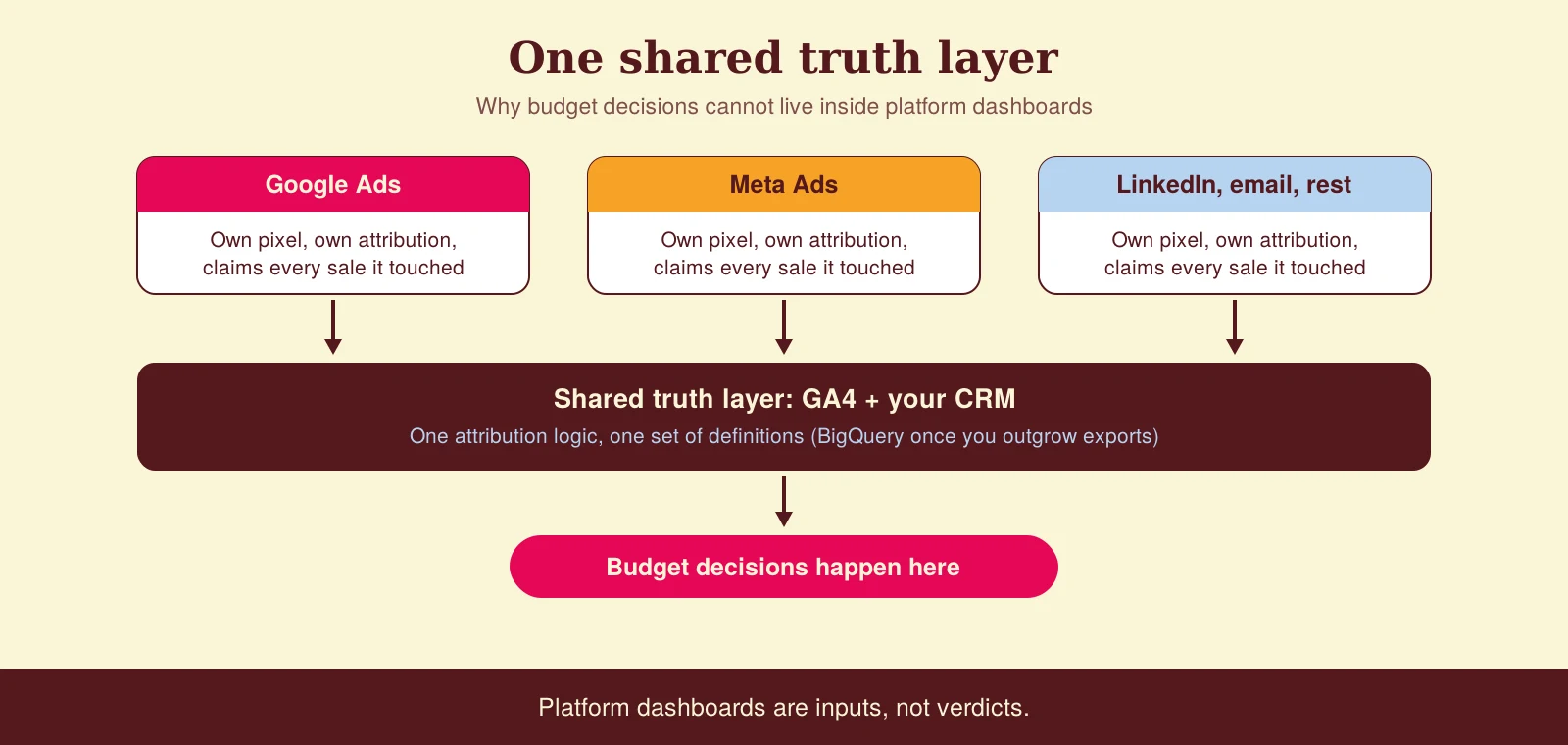
Every ad platform measures itself with its own pixel, its own attribution logic and its own conversion window. Each one reports the conversions it believes it caused. None of them can see the others. So when a customer clicks a Meta ad on Tuesday and a Google ad on Thursday before buying, both platforms may report that sale.
The platforms are not lying. They are answering a narrower question than the one you are asking. They answer “did this person interact with my ad before converting?”. You want to know “where does my next euro of budget do the most work?”. Answering that question takes a measurement layer outside the platforms: GA4, your CRM, and for larger accounts a data warehouse.
Why platform dashboards overcount
Three mechanics cause the overlap. First, each platform uses its own conversion window, so the same sale can sit inside both Google’s and Meta’s window at once. Second, view-through conversions: Meta can claim a sale from an ad that was seen but never clicked, which Google’s click-based reporting counts too. Third, every platform defaults to crediting itself fully for any conversion it touched.
Add measurement gaps on top, consent choices, browser tracking prevention and blocked scripts, and the picture gets noisier still. That is why tracking problems and cross-channel confusion usually show up together: if the inputs per channel are unreliable, no measurement layer on top can fix the comparison.
Coby’s Cross-Channel Measurement Framework
We use the same five steps in every multi-channel account. The order matters, because each step depends on the one before it.
Step 1: Define the events and KPIs that mean revenue
Before any tooling, decide what you are measuring. A brand campaign is judged on reach and engaged sessions. Lead generation is judged on cost per qualified lead, not cost per form fill. E-commerce is judged on ROAS, or better, on profit per sale.
Write these down per channel and per funnel stage. Most cross-channel arguments are really definition arguments: one person quotes cost per click while the other quotes cost per sale, and both think they are talking about performance.
Step 2: Fix the tracking layer first
One shared truth requires clean inputs from every channel. That means conversion tracking that fires once per conversion on every platform, consistent UTM tagging on everything that does not tag itself (email, organic social, partners), and a tag setup managed centrally in Google Tag Manager rather than scattered hardcoded scripts.
Keep UTM conventions boring and documented: lowercase, fixed values for source and medium, one naming pattern for campaigns. A single team member inventing “Facebook”, “facebook” and “fb” as three different sources will quietly split one channel into three rows of your reports.
For accounts with real volume, server-side tagging makes those inputs more complete and more consistent across platforms, because every channel is fed from the same first-party data stream.
Step 3: Bring the data together in one neutral place
GA4 is the practical referee for most SMEs. It sees all channels under one attribution logic, which makes it the first place to compare them fairly. Its channel reports live under Advertising, and Google documents how attribution is handled there in its advertising and attribution documentation.
For B2B, the CRM is the other half of the truth. A channel that produces cheap leads that never become customers is not cheap. Push lead source into your CRM and report cost per customer, not just cost per lead; our B2B lead generation guide covers that loop in detail.
When spreadsheet exports stop scaling, GA4’s free BigQuery export gives you raw event data to join with ad cost and CRM data in a dashboard such as Looker Studio. Useful, but a step for accounts that have already done steps 1 and 2.
Step 4: Use attribution for direction, not as the truth
Older guides, including the first version of this article, listed a menu of attribution models: linear, U-shaped, time decay, multi-touch. That menu no longer exists. Google Ads now offers only data-driven attribution and last click, and GA4 made the same cut. The rule-based middle ground has been retired.
In practice: run data-driven attribution where it is available, and treat its output as a directional signal rather than a verdict. No model can see every touchpoint, offline conversations least of all. For long B2B funnels, the journey picture you actually act on lives in your CRM, not in an attribution report.
Step 5: Test incrementality where volume allows it
The sharpest question in cross-channel measurement is not “which channel gets credit?” but “what happens if I turn this channel off?”. Holdout tests, switching a channel or region off for a few weeks and watching total revenue, and geo tests answer that directly.
These tests need enough conversion volume to read a difference, so for smaller accounts we keep it simpler: watch branded search volume and direct traffic when you scale a demand channel up or down. Meta working upstream of Google is one of the most common cross-channel effects, and we covered how to read it in Google Ads vs Meta Ads.
Common mistakes we see
Adding platform numbers together. Google-reported conversions plus Meta-reported conversions is not a total, it is an overlap. Compare each platform against the shared layer instead.
Reading an attribution switch as a performance change. Change the model and the numbers move while reality stays the same. Note the switch date and never compare across it without that context.
Letting UTM chaos split your channels. Inconsistent tagging quietly fragments channels into multiple rows, which makes every comparison wrong before it starts.
Optimising each channel in its own silo. A SEA specialist tuning Google on Google’s numbers and a social specialist tuning Meta on Meta’s numbers will both look great while the blended picture gets worse. Budget decisions belong at the shared layer.
How Coby approaches this
We are a tracking-first agency, so cross-channel measurement is not a reporting add-on for us. It is the operating system every campaign runs on: first clean per-channel inputs, then one shared truth layer, then budget decisions made there instead of inside platform dashboards.
That order is what changes outcomes. For one B2B client, rebuilding the measurement foundation and judging channels on qualified pipeline instead of platform-reported leads took them from 2 to 3 leads per month to 4 to 5 per week, without a bigger budget.
Our data and analytics service builds exactly this stack, and a free audit will tell you how far apart your platform numbers and your real numbers currently are.
Conclusion
Cross-channel measurement is not a tool you buy, it is an order of operations: define what counts, fix the tracking, pick one neutral layer, use attribution as direction and test incrementality where you can. Do that, and budget conversations stop being dashboard arguments.
Want help setting it up? Get in touch and we will have a look at your channels together.
Frequently asked questions
Why do Google Ads and Meta both claim the same conversion?
Each platform measures with its own pixel, attribution logic and conversion window, and none of them can see the others. A customer who interacted with both channels before buying can legitimately appear in both dashboards, which is why the sum of platform numbers usually exceeds your real sales.
Which attribution models still exist in Google Ads?
Only data-driven attribution and last click. Rule-based models such as linear, time decay and position-based were retired, and GA4 made the same cut. If a report or agency still quotes those models, it is working from an outdated playbook.
What is the best tool for cross-channel measurement for an SME?
Start with GA4 as the neutral layer across channels, plus your CRM if you sell B2B. A data warehouse like BigQuery with a Looker Studio dashboard is worth it once exports stop scaling, but only after the tracking inputs per channel are clean.
What is incrementality testing?
Measuring what a channel adds by comparing what happens with and without it, for example by pausing it in one region. It answers the budget question directly, but needs enough conversion volume to read a reliable difference.
Do UTM parameters still matter in 2026?
Yes, for every channel that does not tag itself automatically: email, organic social, partnerships and offline campaigns with landing pages. Without consistent UTMs, your neutral measurement layer cannot group traffic into channels correctly.
How is cross-channel measurement different from attribution?
Attribution is one component: the logic that divides credit between touchpoints. Cross-channel measurement is the whole system, which also includes clean tracking per channel, one shared data layer and incrementality testing. Good attribution on top of bad tracking still gives wrong answers.
Written by Marloes Slotboom, founder of Coby Agency. Last updated: October 2026.