
Levi’s saw the shift from skinny to baggy jeans coming years before most of the market, and turned it into one of the most quoted martech success stories in retail. The story usually gets told as an AI fairy tale: machine spots trend, brand prints money. The real version is less magical and far more useful, especially if you run a business without a data team.
This post looks at what Levi Strauss & Co. actually built, what the company itself reported, and which parts of the playbook translate to an SME budget. Because the honest answer is: most of it does, just not the way the fairy tale suggests.
What is martech, and why does everyone cite Levi’s?
Martech, short for marketing technology, is the set of tools that collects your marketing data, connects it and turns it into decisions. Analytics, CRM, tag management, automation: that stack is martech.
Levi’s became the go-to example because it is a 172-year-old company that rebuilt itself around data. Its chief digital officer Jason Gowans summed up the starting point in a way most SMEs will recognise: “For far too long, we’ve been data rich, but insights poor.”
That is the actual lesson of the story. Not the jeans. The gap between having data and using it.
What Levi’s actually built
In a 2025 interview on Google Cloud’s own blog, Louis DiCesari, Levi’s global head of data, analytics and AI, described the setup in detail. Three things stand out.
One data foundation instead of scattered reports
Levi’s pulls retail, e-commerce and consumer data onto one cloud platform, with tools like BigQuery and Looker in the mix. The stated goal is a single source of truth: fewer competing dashboards, shared definitions across the company, and data available as a service to the teams that need it.
If that sounds familiar, it should. It is the same problem you have when Google Ads, Meta and your webshop each report a different number of sales. We wrote about that exact problem in our guide to cross-channel measurement.
Domain by domain, not everything at once
DiCesari is explicit that Levi’s did not boil the ocean. The team works domain by domain, starting with pricing data, then consumer data, getting each area to “a 7 or 8 out of 10” before moving on. The full data transformation is planned to take about four years.
That is a large company admitting that sequencing beats scope. Worth remembering next time a tool vendor promises you a 360-degree customer view by Friday.
Where the AI actually sits
Machine learning at Levi’s runs on specific, bounded jobs: pricing optimisation, sizing optimisation, product recommendations. Generative AI drafts product descriptions and translations, with a human reviewing everything before it ships. AI for actual denim design is still in early exploration, because models do not yet capture things like drape and wash.
So no, there is no trend-predicting oracle. There is clean data, applied to narrow questions, with people making the calls.
The baggy jeans story, with the real numbers
The trend itself started around 2020, when fits began shifting from skinny to looser after the pandemic. What the data platform gave Levi’s was not the prediction that baggy would happen. Fashion forecasters were already saying that. It was evidence about who was buying.
The assumption was that looser fits were a Gen Z thing. The data showed otherwise. In DiCesari’s words, it was “everyone, across all age demographics, male, female, everybody”. That changed the size of the bet: bigger inventory positions, the Live Loose campaign in Europe, and sharper conversations with wholesalers.
The results Levi’s reported itself, in its Q2 2024 earnings update: straight, loose and wide-leg fits grew 21% across channels, loose fits made up more than half of the bottoms assortment, the women’s business grew 22% in direct-to-consumer and e-commerce grew 19%.
You may have seen other percentages attached to this story in blogs. Treat those with suspicion. The figures above are the ones the company put its name under.
The Levi’s playbook at SME scale
You do not need Levi’s stack to copy Levi’s logic. Here is the same playbook, sized for a business where marketing is one person and a budget, not a department.
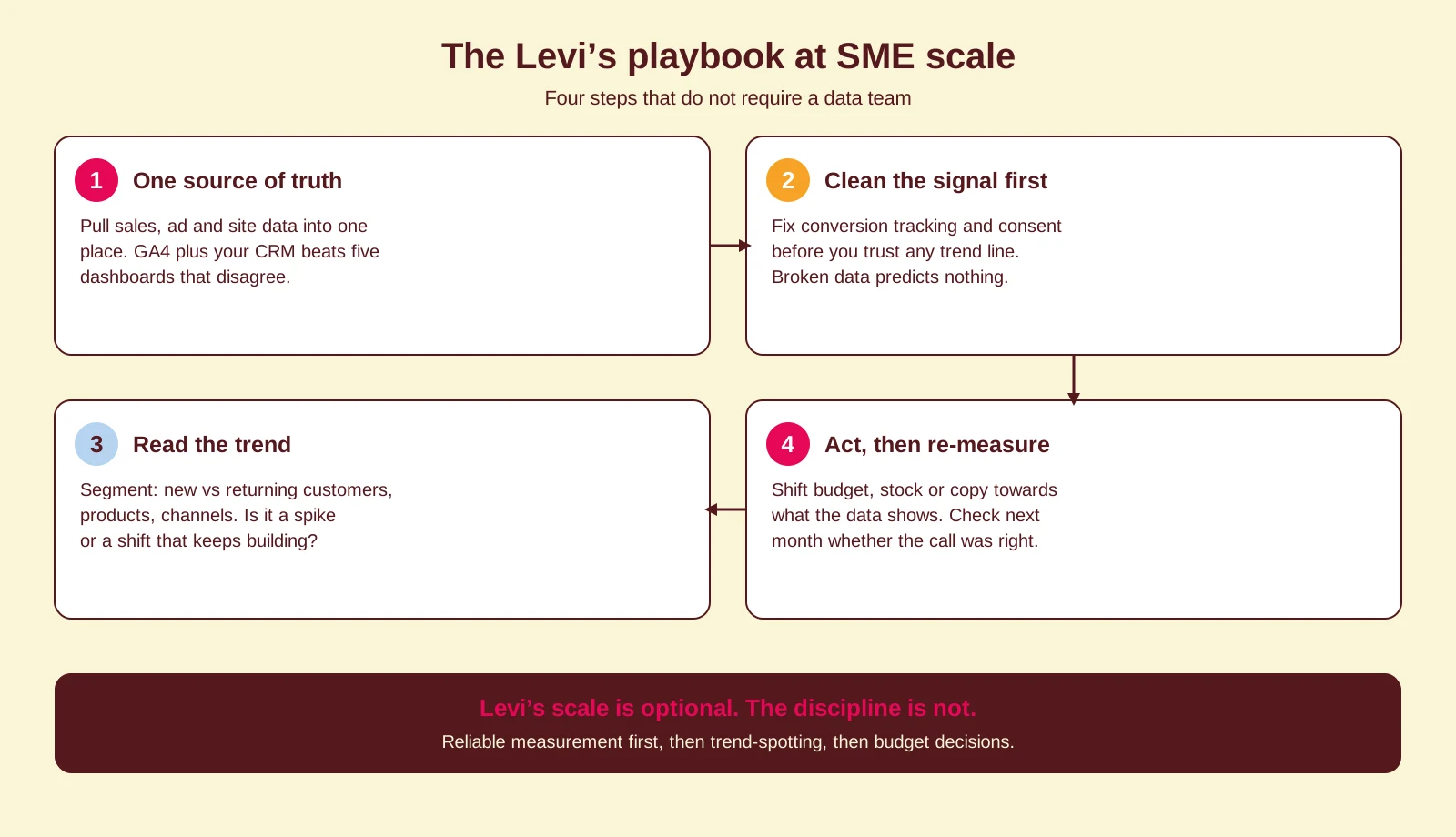
- Build one source of truth. Get your sales, ad and site data into one place you trust. For most SMEs that is a well-configured GA4 property connected to your CRM or webshop backend, not a data warehouse. If you do outgrow the interface, GA4’s free BigQuery export is the same route Levi’s uses, at a fraction of the complexity.
- Clean the signal before you read it. Levi’s spent years on data quality before leaning on the insights. Your version of that is making sure conversion tracking fires once per sale, consent is handled properly and your first-party data is collected deliberately. Broken data predicts nothing.
- Read the trend in segments. The Levi’s insight was not “baggy is growing”, it was “baggy is growing in every segment”. Apply the same cut to your own numbers: new versus returning customers, product lines, channels, regions. A spike in one segment is noise. Growth across segments is a shift worth funding.
- Act, then re-measure. Shift budget, stock or messaging towards what the data shows, then check a month later whether the call was right. Levi’s reviews whether predicted trends actually materialised. So should you, just with a shorter cycle.
Common mistakes we see
When SMEs try to go data-driven, these four patterns come up in almost every audit.
Buying tools before fixing measurement. A CDP subscription does not repair a GA4 property that double-counts purchases. Fix the foundation first; it is usually cheaper than the tool.
Treating platform dashboards as the truth. Google Ads and Meta each claim conversions using their own attribution. Added together they will flatter you. One neutral measurement layer settles the argument.
Confusing a spike for a trend. One good week after an influencer mention is not your baggy jeans moment. Segment it, compare it to last year, and see if it holds before you reorder stock.
Collecting data nobody acts on. If no decision changes based on a report, the report is decoration. Levi’s ties every data domain to decisions about pricing, sizing or campaigns. Steal that habit.
How Coby approaches this
Coby is a performance marketing agency, not a billboard for enterprise software, so our version of martech starts smaller and more honest: tracking first. Before we scale any campaign, we make sure the conversion data is complete and deduplicated, from the first click to the CRM. That is the SME equivalent of Levi’s data foundation, and we consider it the first thing worth fixing in any account.
The same discipline pays off quickly. For one B2B client, rebuilding the measurement layer and then reallocating budget on reliable data took lead flow from 2 to 3 leads per month to 4 to 5 per week. No trend oracle involved, just decisions made on numbers that were finally correct.
For the behavioural side, we pair GA4 with Microsoft Clarity, which shows you why pages underperform while GA4 shows you where. If you want the full comparison, read Microsoft Clarity vs GA4. And when client-side data gets thin, server-side tagging is how we keep the signal clean.
Curious what your own data foundation looks like? Our free audit checks it, or see what our data and analytics service covers.
Conclusion
The Levi’s story is real, but the headline is wrong. The company did not win because an AI predicted baggy jeans. It won because years of unglamorous data work meant that when the trend arrived, it could see exactly who was buying and act with confidence.
That part scales down. One source of truth, clean tracking, segmented reading, decisions that get re-measured. If you want help building that foundation, talk to us.
FAQ
What is martech?
Martech, short for marketing technology, covers the tools that collect, connect and act on your marketing data: analytics, CRM systems, tag management and automation platforms. The goal is making decisions on evidence instead of gut feeling.
How did Levi’s spot the baggy jeans trend early?
Fashion forecasters flagged the shift to looser fits; Levi’s data platform showed it was happening across all ages and genders, not just Gen Z. That evidence justified bigger inventory and marketing bets than a hunch would have.
What results did Levi’s actually report?
In its Q2 2024 earnings update, Levi’s reported that straight, loose and wide-leg fits grew 21% across channels and that loose fits made up more than half of its bottoms assortment. Percentages beyond the company’s own reporting are best treated as blog folklore.
Do small businesses need a data warehouse like Levi’s?
No. A correctly configured GA4 property connected to your CRM or webshop covers the same decisions at SME scale. GA4’s free BigQuery export exists if you ever need more depth.
What should an SME fix first before copying Levi’s approach?
Conversion tracking. If your sales and leads are miscounted, every trend you read on top of them is fiction. Clean measurement first, then trend-spotting, then budget decisions.
Can AI predict trends for my business?
AI is good at narrow jobs on clean data, like recommendations or pricing, and Levi’s uses it exactly that way. Trend prediction still comes from humans reading well-segmented data, so invest in the data before the prediction.
Written by Marloes Slotboom, founder of Coby Agency.
Last updated: October 2026