
Google Ad Grants is one of the most underused opportunities available to charities right now. The programme gives eligible nonprofits up to $10,000 USD a month in free Google Ads credit, and a large share of qualifying organisations have either never heard of it or tried once, hit a policy wall, and gave up.
In 2026, that is a costly gap. Fundraising is harder than it used to be, donor attention is fragmented, and competition for every euro of charitable income keeps rising. Google Ad Grants will not fix all of that, but for organisations that use it well, it can shift the needle considerably.
This guide covers what the grant actually is, the rules that get accounts suspended, and how to build campaigns that keep the credit working month after month.
What is Google Ad Grants in 2026?
Google Ad Grants is a donation programme that gives qualifying nonprofits up to $10,000 USD per month in Google Ads credit, which works out to a daily budget of about $329. The core concept has not changed in years, but the performance rules have tightened, and they are enforced.
The credit works like a standard Google Ads budget, with restrictions. You can only run Search campaigns with text ads. Keywords have to be relevant to your mission. And you need to hit performance benchmarks to stay in the programme, the most important being a 5% click-through rate at account level each month.
There is also the famous $2 bid cap, and this is where most outdated advice goes wrong. The $2.00 USD max CPC only applies to manual bidding. Accounts using conversion-based Smart Bidding, such as Maximise conversions or Target CPA, are not held to the cap, and Google requires newer grant accounts to use conversion-based Smart Bidding anyway. In practice, the bid cap is close to irrelevant for a properly configured account.
Approval runs through Google for Nonprofits and involves proving charitable status, having a substantive website, and building campaigns that comply with the Ad Grants policies.
Why the grant is worth the effort
Start with the numbers. Using the full monthly allowance works out to $120,000 USD a year in advertising value. Many smaller charities operate on total budgets not far above that figure.
Beyond the financial case, search advertising connects you with people who are already looking for what you do. Social ads interrupt people mid-scroll. Search puts you in front of someone who just typed “wildlife conservation donations” or “volunteer homeless shelter Amsterdam”. They have already raised their hand, and the quality of that traffic tends to be meaningfully higher.
There is a longer-term benefit too. Running a grant account properly forces an organisation to get better at digital marketing. You improve your website, you start tracking what actually converts, and you build habits around measurement. Those skills do not disappear when a campaign ends.
The rules that actually get accounts suspended
Google has made it clear the grant is not a passive benefit. These are the requirements that matter in 2026:
- 5% click-through rate, every month. Measured at account level. Two consecutive months below 5% leads to temporary deactivation. Commercial Search campaigns often run at 2 to 3%, so this forces genuinely relevant ads and tight keywords.
- Conversion-based Smart Bidding and real conversion tracking. Newer grant accounts must use strategies like Maximise conversions or Target CPA, and Google expects at least one meaningful conversion per month. Homepage visits do not count as meaningful.
- Keyword quality rules. Single-word keywords are banned, with a handful of exceptions such as your brand name and words like “donate”. Overly generic terms are banned too, and keywords with a Quality Score of 1 or 2 must be paused or removed.
- Account structure minimums. At least two ad groups per campaign, two ads per ad group, and two sitelink assets.
- Geo-targeting. Ads must target the locations where your organisation is actually relevant.
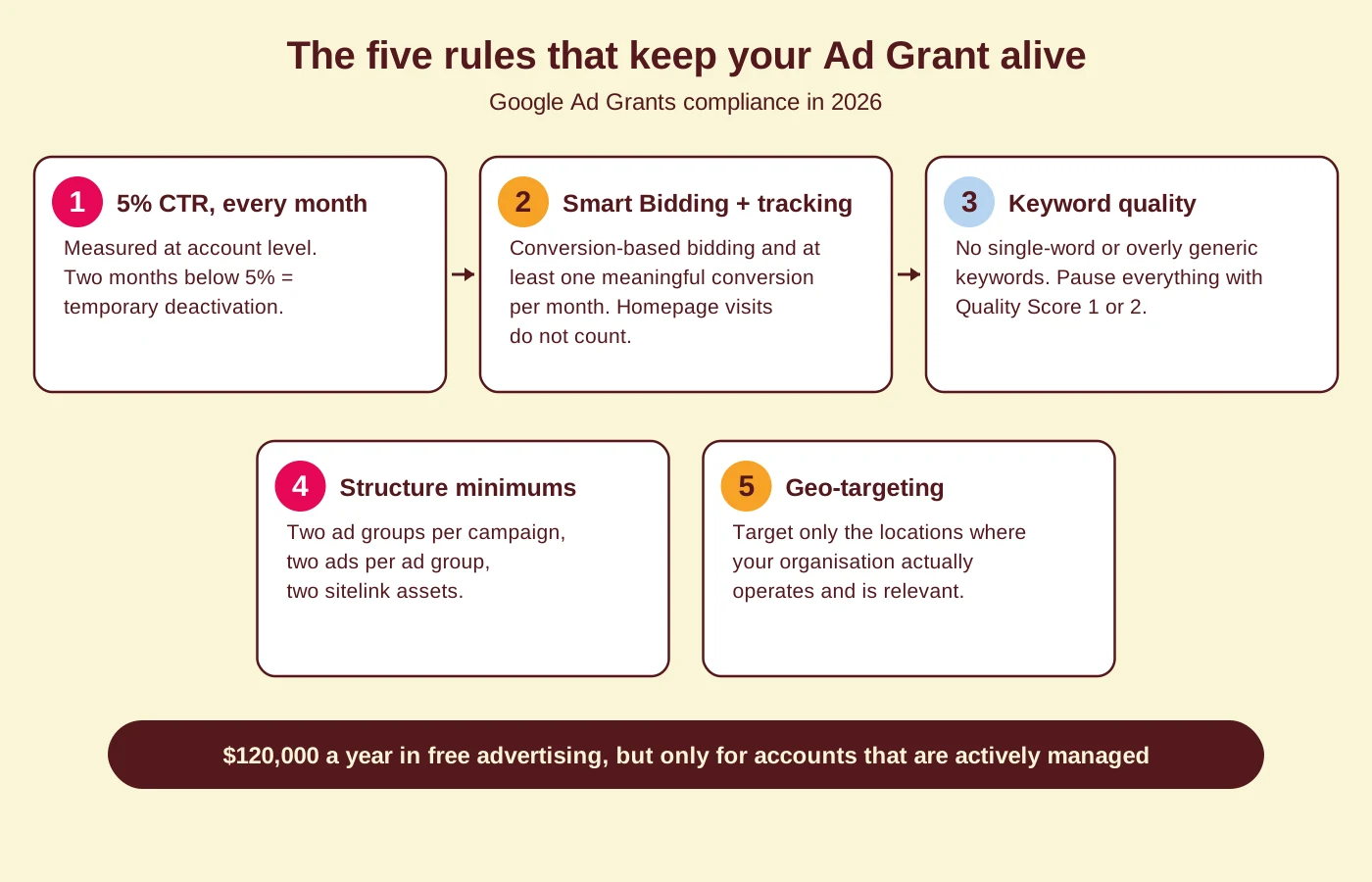
The CTR requirement is the one that catches most organisations out, but it is not necessarily a bad thing. It pushes nonprofits to write better ads than they might otherwise bother with.
One correction to advice you may read elsewhere: broad match keywords are not banned. The bans are on single-word and overly generic keywords and on low Quality Score keywords. With Smart Bidding in place, broad match can work, as long as you watch the search terms report and keep adding negatives.
How to apply: three phases
There are three phases: eligibility verification, account setup, and campaign launch. Skipping steps in phase one causes painful delays later.
- Get verified through Google for Nonprofits. You need valid charitable status in your country, a website with real content about your work, and agreement to Google’s non-discrimination and donation policies.
- Fix your website first. This is where many applications fall apart. Google expects something substantive: programme descriptions, impact stories, a working donation mechanism, and content that is clearly maintained. A half-built site with placeholder pages will not pass.
- Apply for Ad Grants and build compliant campaigns. Create the Ad Grants account through your Google for Nonprofits profile, set up conversion tracking before you launch, and structure campaigns within the rules above.
Campaign structure that keeps you compliant
Ad groups should be specific. A homelessness charity might run separate ad groups for “homeless shelter donations”, “volunteer opportunities homelessness” and “homeless prevention programmes”. That granularity keeps relevance high and click-through rates where they need to be.
Geographic targeting matters more than most people realise. A local food bank that targets nationally will burn through relevance on traffic that was never going to convert. Keep targeting tight to where you actually operate.
Landing pages are the other big lever. Sending grant traffic to your homepage is a waste. Someone who searched “animal rescue donations” should land on your donations page, not scroll through your site to find it. Specificity improves conversions and satisfies Google’s quality expectations at the same time.
And treat the account as a living thing. Organisations that treat the grant like a direct debit that runs itself lose it. Review search terms, prune weak keywords, refresh ads. It needs attention, regularly.
Measure beyond the compliance numbers
Google’s 5% CTR requirement is a floor, not a goal. Organisations that get the most out of their grant track what happens after the click: donations, newsletter sign-ups, volunteer enquiries, event registrations.
This is where our tracking-first approach applies just as much to nonprofits as to commercial advertisers. If your conversion data is wrong, Smart Bidding optimises toward the wrong thing with your free budget, and you learn nothing about what works. We wrote about why tracking is the first thing we fix in any account; a grant account is no exception.
Quality Score is worth watching too. Higher scores mean better ad positions for the same budget, and they keep you clear of the automatic keyword rules.
How Coby Agency approaches Ad Grants
Where most grant setups focus on meeting the minimum requirements, our approach starts with how people actually search for what a nonprofit does.
A mental health charity might assume “mental health donations” is their main keyword. They are probably missing “anxiety support groups”, “depression counselling services” and a dozen other searches from people who might engage or give. Proper keyword research uncovers that full picture while staying within grant policy.
We build campaigns with growth in mind: structures that can scale, take seasonal pushes, and expand as services expand, rather than campaigns that need rebuilding every six months. And on the tracking side we go well beyond what Google requires, so the organisation can prove the grant’s value internally.
We also train the nonprofit’s team along the way. The goal is that they can manage and develop campaigns independently over time. Indefinite dependency on an agency is not in anyone’s interest.
If you want support getting it right from the start, our Google Ads team works with organisations on exactly this. Get in touch and we will have a look at your situation.
Frequently Asked Questions
How much is the Google Ad Grant worth?
Up to $10,000 USD per month in Google Ads credit, which equates to a daily budget of about $329. Used fully, that is $120,000 a year in advertising value.
Does the $2 bid cap still apply?
Only to manual bidding. Accounts using conversion-based Smart Bidding strategies such as Maximise conversions or Target CPA are not limited to the $2.00 max CPC, and Google requires newer grant accounts to use those strategies anyway.
What happens if my nonprofit misses the 5% click-through rate?
Accounts that fall below 5% CTR for two consecutive months face temporary deactivation. You can get reinstated after fixing the underlying issues, but prevention is far easier: tight keywords, relevant ads and regular pruning keep CTR healthy.
Can nonprofits use Google Ad Grants for fundraising campaigns?
Yes, and it is one of the most effective uses of the programme. Campaigns need to be tied to your specific cause rather than generic terms. “Wildlife conservation donations” is fine; a single-word keyword like “charity” is only allowed within Google’s short exception list.
Are broad match keywords banned in Ad Grants?
No. The keyword rules ban single-word keywords (with limited exceptions), overly generic terms, and keywords with a Quality Score of 1 or 2. Broad match is allowed, and works best combined with Smart Bidding and an actively managed negative keyword list.
How long does approval take?
It varies by country and by how complete your application is. Google for Nonprofits verification usually takes days to a few weeks, with the Ad Grants activation following after. A website that is clearly unfinished is the most common cause of delay.
Last updated: October 2026
Written by Marloes Slotboom, founder of Coby Agency