
More and more of your potential clients are not taking their questions to Google any more. They are asking ChatGPT, Perplexity or Google AI Mode instead. The answer they get back names a handful of companies and sources. If you are not one of them, you simply did not exist for that person.
Generative engine optimisation (GEO) is how you earn a place in those answers. This guide is written for founders and marketing managers who handle most of their marketing themselves and want to know what actually works, without the AI hype.
After reading, you will know what GEO is, which three factors decide whether AI platforms cite you, how to get started with the Coby GEO Action Framework, and how a monthly AI audit makes your progress measurable.
This pillar was fully rewritten in September 2026 with the latest verified platform facts and our AI audit method.
What GEO is and what it is not
GEO is the practice of building your content and your authority so that AI platforms such as ChatGPT, Perplexity and Google AI Mode cite your site or recommend your brand in their answers. That is different from SEO, where you optimise to rank in a list of search results.
GEO does not replace SEO. It is an extra layer on top. But the two are drifting apart: the overlap between Google’s top 10 and the sources AI engines cite has dropped from roughly 70% to below 20%. Ranking well is no longer a guarantee that AI mentions you.
What GEO also is not: a trick or a tool you switch on. It is mostly very good content work, plus authority beyond your own site, plus measurement. That last part gets skipped almost every time, and it is exactly what the second half of this guide covers.
Where AI search stands in 2026
The short version: AI search has gone mainstream, but the classic search result is far from dead.
A few verified facts in a row:
- Google AI Mode is free, available in more than 200 countries and around 100 languages, and counts over 1 billion monthly users (Google I/O 2026).
- AI Overviews were folded into AI Mode in May 2026. AI Mode is explicitly not Google’s default view.
- Ads in AI Mode are currently only being tested in the US.
- According to Pew Research (July 2025), only 8% of users click a traditional result when an AI summary sits above it, against 15% without one.
That last number is the heart of the story. Even if you hold your position, that position earns fewer clicks once an AI answer appears above it. Being named inside that answer is becoming steadily more valuable.
The GEO Triangle: three factors that decide whether AI cites you
In practice, whether AI cites you comes down to three things: relevance, authority and extractability. We call this the GEO Triangle.
Relevance
AI engines look for the most specific answer to a narrow question. A page that fully answers one question beats a broad page that touches ten topics. Write ten sharp articles rather than one vague catch-all.
Authority
AI systems lean heavily on what others say about you: trade media, review platforms, directories and other external sources. For GEO, mentions beyond your own site often carry more weight than anything you claim on your own blog. Earned media is no longer a nice-to-have.
Extractability
The AI has to be able to lift your answer out easily. Short sentences, clear headings, answer-first writing, FAQ sections and tidy lists all help. A wall of text rarely gets cited, however good the content is.
This is not guesswork. The GEO study by Princeton and IIT Delhi (KDD 2024) tested nine optimisations. Citing sources, adding quotes and including statistics each lifted visibility in AI answers by roughly 30 to 40%. Keyword stuffing did almost nothing. And notably: lower-ranking sites benefit the most.
How AI platforms differ in what they cite
Each platform has its own preferences, and you can see it in who gets cited.
Perplexity shows its sources prominently and leans strongly on current content. Regularly updated pages with a visible date do well there.
ChatGPT likes to pull in thorough guides and comparisons for search-style questions, and condenses them into a recommendation. Comparison content with clear criteria gets picked up there often. Our Google Ads vs Meta Ads comparison is exactly the kind of format this rewards.
Google AI Mode builds on what Google already knows about your site. Structured data such as FAQ schema and technically healthy pages help most here.
You do not need separate content for each platform. Get the GEO Triangle right and you score on all of them at once. In your measurement, though, you do want to track them separately, and that is what the AI audit is for.
The Coby GEO Action Framework: six steps
Here is how you turn this into work you can schedule this month, in order of priority:
- Write answer-first. Open every section with the direct answer in one or two sentences, then expand on it.
- Add an FAQ section to every important page and have your developer add FAQ schema.
- Use specific numbers and name your sources. This is exactly the behaviour the Princeton study rewards.
- Keep content current. Put “Last updated” on the page and properly refresh your most important pages a few times a year.
- Build authority beyond your site. Trade media, guest contributions, review platforms and relevant directories.
- Check your robots.txt. Some CDNs and firewalls, including Cloudflare, block AI crawlers by default. If you are not crawled, you will not be cited.
And llms.txt? Save yourself the effort. Google confirms that no AI system uses it, and an Ahrefs analysis of 137,000 sites shows that 97% of llms.txt files are never requested.
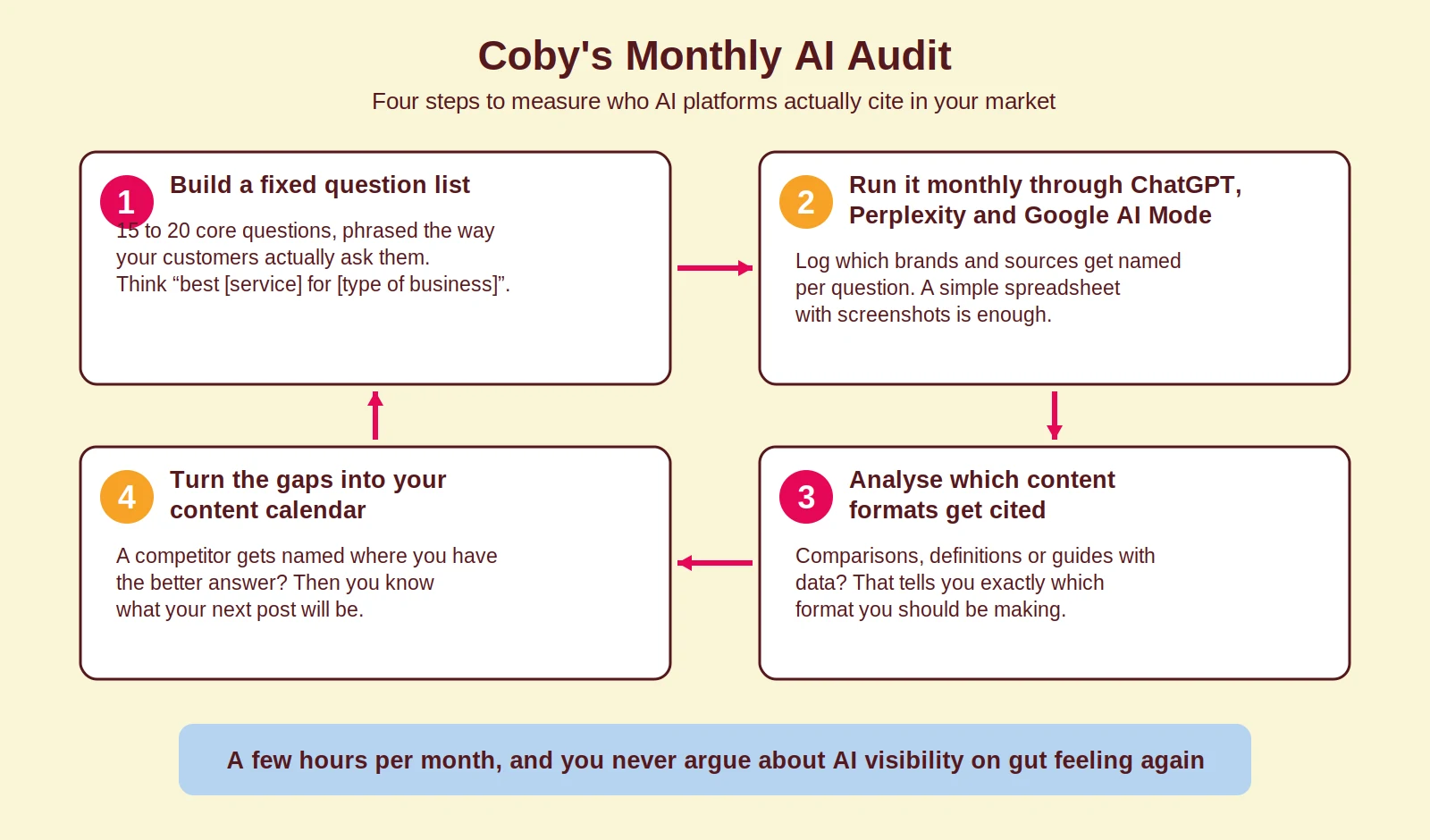
Coby’s Monthly AI Audit: four steps
The fastest way to get a grip on GEO is to measure where you stand today. You do that with a recurring AI audit: asking the same AI platforms the same questions every month and recording who gets named.
This is how we run it:
- Build a fixed question list. Pick 15 to 20 core questions, phrased the way your customers actually ask them. Think “best [service] for [type of business]” and “which tool solves [problem]”.
- Run the list monthly through ChatGPT, Perplexity and Google AI Mode. Record per question which brands and sources get named. A simple spreadsheet with screenshots is enough.
- Analyse which type of content gets cited. Is it comparisons, definitions or guides with data? That tells you exactly which format you should be making.
- Turn the gaps into your content calendar. If a competitor shows up on a question where you have the better answer, you know what your next post will be. Repeat the audit monthly so you can see the shifts.
Complement this with brand mention monitoring, for example through Google Alerts. AI answers regularly name your brand without linking to you, and you want those mentions on your radar.
How to measure GEO traffic in GA4
You cannot measure it completely yet, but you can get a long way.
GA4 now has its own AI Assistant channel, which collects traffic from ChatGPT, Gemini and Copilot among others. Perplexity still falls outside it; for that you create a custom channel rule on referrals from perplexity.ai. Links from ChatGPT also carry utm_source=chatgpt.com.
Keep in mind that many AI sessions arrive without a referrer and land in Direct. You are structurally undercounting AI traffic, not overcounting it. So if GA4 shows you a little AI traffic, the real number is almost certainly higher.
If you want to see what those visitors do next on your site, a behaviour tool alongside GA4 is worth its weight in gold. How we approach that is covered in our comparison of Microsoft Clarity and GA4. And why we always fix measurement before we optimise is explained in our tracking-first approach.
The honest picture
Google is still by far your biggest traffic source, and that will stay true for a while. In absolute numbers, AI traffic is small.
There are two good reasons to start now anyway. AI visitors arrive pre-informed: they have already read your recommendation, and they tend to convert well because of it. And most of your competitors are doing nothing about GEO yet, so the room to stand out is larger now than it will be in two years.
GEO is not a replacement for your SEO or advertising strategy. It is a relatively small, recurring effort with a compounding effect.
How Coby approaches this
We start with measurement, not with optimisation. The same tracking-first approach we use for Google Ads and Meta is what we apply to GEO: first the monthly AI audit and the GA4 setup, then the content decisions.
That way you are not debating on gut feeling but on recorded answers: which questions, which platforms, who gets named and what has changed since last month. And because we run campaigns across very different sectors, from dental practices to sustainable packaging, we quickly recognise which type of question makes the difference in your market.
Curious where you stand in AI answers today? Have a look at our GEO services or our data and analytics services. You talk directly to the person who does the actual work.
Conclusion
GEO decides whether AI platforms cite you when your customers put their questions to ChatGPT, Perplexity or Google AI Mode. The basics are manageable: write answer-first, build authority beyond your site, and measure monthly with an AI audit.
Start with that audit. It costs a few hours a month and tells you exactly where your opportunities are. Need help setting it up? Get in touch.
Frequently asked questions
What is the difference between SEO and GEO?
SEO optimises content to rank in Google’s search results; GEO optimises content to be cited in AI answers from platforms such as ChatGPT, Perplexity and Google AI Mode. You need both, but the rules differ.
Does ranking well in Google also help with GEO?
Partly. The overlap between Google’s top 10 and AI citations has dropped to below 20%, so a top position is no guarantee. Strong authority and well-structured content do help with both.
How quickly do you see results from GEO?
Content and structure changes can show up in AI answers within a few weeks, because many platforms consult current sources. Building authority through external mentions takes months rather than weeks.
Do I need an llms.txt file?
No. Google confirms that no AI system uses llms.txt, and Ahrefs research across 137,000 sites shows that 97% of those files are never requested. Put that time into answer-first content and earned media instead.
Can a small business compete with big brands in AI answers?
Yes. The Princeton GEO study shows that lower-ranking sites benefit most from GEO optimisations. Specific and concrete regularly beats big and generic in AI answers.
Last updated: September 2026
Written by Marloes Slotboom, founder of Coby Agency